

TL;DR:
- Optimizing for Google SGE results relies on creating well-structured, authoritative content that AI systems can easily extract and cite, with traditional SEO signals still foundational.
- Key strategies include implementing direct answers at section starts, utilizing FAQPage schema, and building topic clusters to enhance AI visibility and coverage.
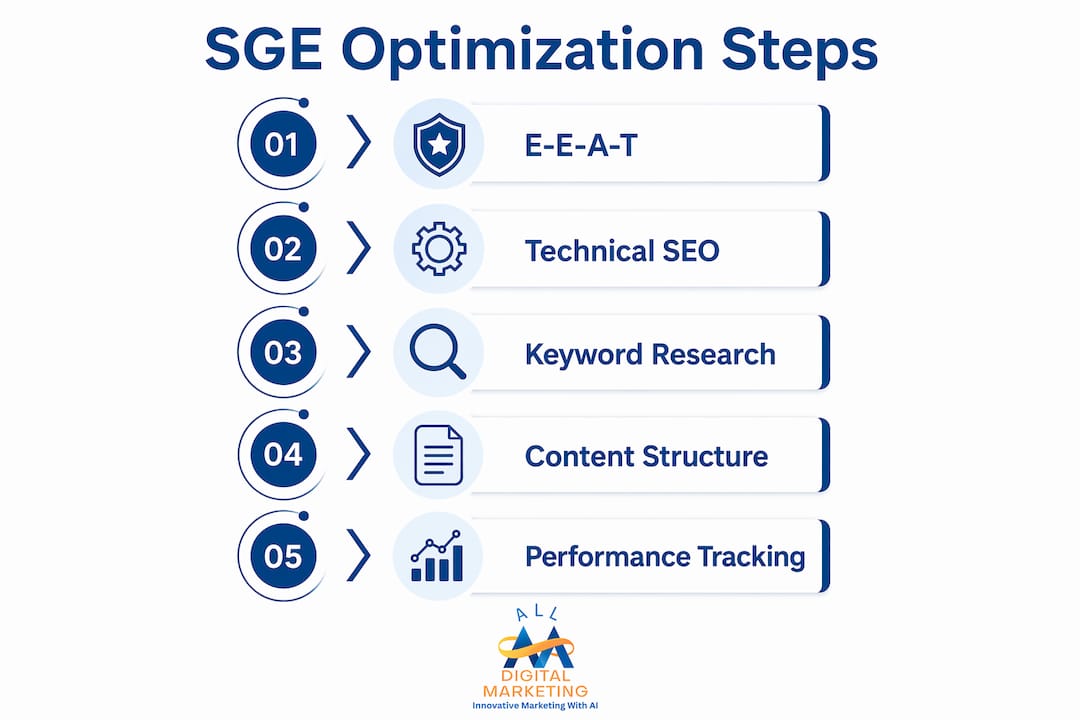
Optimizing for Google SGE results means structuring authoritative, well-organized content so Google's AI Overviews and AI Mode can extract, cite, and surface it in generative search summaries. Google's core Search systems still govern generative AI features, which means traditional SEO best practices remain the foundation. What has changed is the layer on top: content must now be designed for AI extraction, not just human readers. Google Search Console's new generative AI performance reports, announced June 1, 2026, give marketers a direct window into AI impression data for the first time. Tools like FAQPage schema, topic clusters, and structured answer formats are now as important as backlinks and page speed. This guide walks you through every layer of that strategy.
How to optimize for Google SGE results: the SEO foundation that still matters
SEO remains foundational for success in AI search features, including AI Overviews and AI Mode, according to Google's May 2026 guidance. That statement carries real weight: no amount of AI-specific formatting will compensate for weak authority, poor crawlability, or thin content. The path to SGE visibility starts with the same signals that have always driven Google rankings.

E-E-A-T signals are the entry ticket
Google's E-E-A-T framework, which stands for Experience, Expertise, Authoritativeness, and Trust, determines whether your content qualifies as a credible source for AI-generated summaries. Pages that demonstrate first-hand experience, cite verifiable data, and earn links from recognized industry sources consistently outperform generic content in AI Overviews. For local businesses, this means publishing case studies, client results, and staff credentials directly on the page.
Google's John Mueller has confirmed that generative AI features rely on core search quality signals rather than AI-specific tricks. That means investing in genuine expertise signals is not optional. It is the primary ranking mechanism.
Technical SEO: the non-negotiable baseline
Site speed, mobile-friendly design, and clean crawlability are prerequisites for SGE visibility. Google cannot extract content from pages it cannot efficiently crawl and render. Core Web Vitals scores directly affect how quickly and reliably Google's systems process your pages for AI summarization.
Quality backlinks remain a strong authority signal. Pages cited in AI Overviews tend to carry above-average domain authority, which reflects the trust signals Google's systems weigh when selecting sources for generative summaries. Building links from authoritative industry publications, local directories, and partner sites still moves the needle.
Keyword research adapted for entities and topics
Traditional keyword research is still useful, but the focus has shifted from exact-match phrases to entities and topic coverage. Google's AI systems understand concepts and relationships, not just strings of text. Targeting a topic cluster, such as "commercial plumbing repair" alongside related sub-topics like "pipe inspection," "water pressure issues," and "emergency shutoff valves," signals comprehensive authority to both traditional and generative search systems.
You can explore how foundational SEO approaches apply directly to AI-powered SGE features in Digitalmarketingall's GEO strategy guide.
- Publish content that demonstrates direct experience with the topic, not just research summaries
- Earn backlinks from recognized industry sources and local business directories
- Pass Core Web Vitals benchmarks for Largest Contentful Paint, Interaction to Next Paint, and Cumulative Layout Shift
- Align every page to a clear, specific user intent before adding any AI-focused formatting
- Use Google Search Console's coverage and indexing reports to confirm all target pages are fully crawlable
Pro Tip: Run a crawl of your site with Screaming Frog or Sitebulb before investing in AI content formatting. If Google cannot efficiently access your pages, no amount of schema markup or structured answers will improve your SGE visibility.
How should you structure content for AI extraction and citation?
AI Overviews favor content with direct answers placed at section starts and structured formats like lists and tables for extractability. This is the single most important structural shift for SGE optimization. The AI does not read your page the way a human does. It scans for discrete, verifiable answer units at predictable locations.
Pages with clearly defined answer units, such as definitions and lists placed consistently at the start of sections, show higher citation rates in AI Overviews. The practical implication: every H2 and H3 section should open with a one to two sentence direct answer before expanding into supporting detail.
Step-by-step: structuring a page for SGE citation
- Open each section with a direct answer. State the core claim or definition in the first sentence of every section. Do not build up to the answer. Lead with it.
- Use numbered lists for processes. When explaining a sequence of steps, numbered lists signal clear procedural structure that AI systems extract reliably.
- Use comparison tables for decisions. When readers need to choose between options, a two-column or three-column table gives AI systems clean, structured data to cite.
- Add specific data points and named examples. Vague claims are skipped. Specific figures, named tools, and verifiable facts are cited. Replace "many businesses use this approach" with "brands like HubSpot and Moz publish topic cluster content to maximize AI Overview coverage."
- Implement FAQPage schema with JSON-LD. Google advises marking up visible Q&A content using FAQPage schema and validating it with the Rich Results Test. This gives AI systems machine-readable Q&A pairs that map directly to conversational search queries.
- Build topic clusters to address query fan-out. Google's Gemini supports multi-turn AI exploration, meaning a user's initial query often expands into follow-up questions. Content that anticipates and answers adjacent sub-questions earns broader AI Overview coverage across multiple related searches.
Comparison: traditional SEO content vs. SGE-optimized content
| Content Element | Traditional SEO Approach | SGE-Optimized Approach |
|---|---|---|
| Section opening | Context or background first | Direct answer in sentence one |
| Format | Long narrative paragraphs | Mix of paragraphs, lists, and tables |
| Schema markup | Title, meta description, basic schema | FAQPage, HowTo, and Article JSON-LD |
| Topic scope | Single keyword focus | Topic cluster covering related sub-questions |
| Data usage | Optional supporting detail | Named entities and specific figures required |
Pro Tip: Validate your FAQPage and HowTo schema using Google's Rich Results Test at search.google.com/test/rich-results before publishing. Silent markup errors prevent AI systems from reading your structured data, and they will not show up in standard page audits.
How to use Google Search Console's generative AI reports
The Search Console generative AI performance reports provide AI feature impressions, pages, countries, devices, and dates, but not clicks or click-through rate. This distinction matters. Impressions in the AI report tell you how often your content appeared inside an AI Overview or AI Mode response. That is a brand visibility metric, not a traffic metric, and it requires a different measurement framework.
AI impression trends can guide optimization decisions, while conversions are still tracked through linked analytics systems. Linking Google Search Console with Google Analytics 4 is the practical solution. When you see a page earning strong AI impressions but low GA4 conversions, that signals a content gap: the page is being cited but not compelling enough to drive action after the user clicks through.
Reading the generative AI performance report
The report surfaces four key dimensions: which pages earn AI impressions, which countries and devices generate those impressions, and how impression volume trends over time. Use the pages dimension first. Sort by impressions to identify your top-cited content, then cross-reference those URLs in GA4 to check organic session volume and goal completions.
Pages that earn AI impressions but show declining organic clicks may be experiencing zero-click behavior, where users get their answer directly from the AI Overview without visiting your site. For those pages, the strategic response is to deepen the content so the AI Overview creates curiosity rather than fully resolving the query.
Acting on the data: a practical workflow
| Report Signal | What It Means | Recommended Action |
|---|---|---|
| High AI impressions, low organic clicks | Zero-click behavior likely | Add depth, proprietary data, or a strong CTA above the fold |
| Low AI impressions on a strong organic page | Content not structured for extraction | Add direct answers at section starts and FAQPage schema |
| AI impressions growing month over month | Content is being cited more frequently | Expand the topic cluster to capture adjacent queries |
| AI impressions dropping after a content update | Update may have removed cited answer units | Restore direct answer formatting at section openings |
Pro Tip: Set up a custom GA4 segment for sessions originating from organic search on pages that appear in your Search Console AI impressions report. This lets you track whether AI-cited pages are actually converting visitors, which is the business outcome that matters most.
Opting out of AI citation disables impressions from AI features but does not affect traditional search ranking or organic traffic. This is worth knowing before you make any opt-out decisions. Opting out removes your content from AI Overviews and AI Mode without any ranking penalty for standard blue-link results.
What are the most common SGE optimization mistakes to avoid?
Google's 2026 guide explicitly debunks the myth that content needs special AI-specific chunks or rewrites to perform well in SGE. This is one of the most widespread misconceptions in the SEO community right now, and acting on it wastes significant time and budget.
The mistakes below are not theoretical. They represent patterns that Digitalmarketingall sees regularly when auditing sites that are underperforming in AI Overviews despite strong traditional SEO metrics.
- Chunking content artificially. Breaking pages into short, disconnected fragments to mimic AI training data does not improve citation rates. Google understands multi-topic pages. What matters is answer placement, not content fragmentation.
- Keyword stuffing for AI visibility. Repeating target phrases at high density does not increase the likelihood of AI citation. Google's systems evaluate semantic relevance and authority, not keyword frequency.
- Creating AI-only schema or markdown versions. There is no separate AI indexing system that reads a special version of your page. Google processes the same HTML that users see. Maintaining a hidden AI-optimized version of your content is unnecessary and potentially counterproductive.
- Ignoring foundational SEO in favor of AI hacks. Pages with weak authority, slow load times, or poor mobile experience will not earn AI citations regardless of how well they are formatted. The foundation must be solid before the AI layer adds value.
- Measuring only clicks. If your reporting framework tracks only organic clicks, you are missing the full picture of SGE performance. AI impressions in Search Console represent brand exposure that influences purchase decisions even without a click. Update your KPI framework to include both.
- Using misleading or artificial mentions. Attempting to manipulate AI citations through fabricated authority signals, fake reviews, or misleading content descriptions violates Google's quality guidelines and risks manual action.
Key takeaways
Optimizing for Google SGE results requires strong E-E-A-T signals, direct-answer content structure, FAQPage schema, and active monitoring through Search Console's generative AI performance reports.
| Point | Details |
|---|---|
| SEO foundation first | E-E-A-T, Core Web Vitals, and quality backlinks govern AI Overview eligibility before any formatting tactics apply. |
| Direct answers at section starts | Place the core claim or definition in sentence one of every section to maximize AI extraction and citation rates. |
| FAQPage schema with validation | Implement JSON-LD FAQPage markup on visible Q&A content and validate with Google's Rich Results Test to avoid silent errors. |
| Use Search Console AI reports | Monitor AI impressions by page, then link with GA4 to connect visibility data to actual business conversions. |
| Avoid AI-specific gimmicks | Content chunking, keyword stuffing for AI, and hidden AI versions are unnecessary and confirmed ineffective by Google's 2026 guidance. |
Why I think most SGE advice is solving the wrong problem
I have spent the past several months reviewing SGE optimization strategies from across the industry, and the pattern I keep seeing is this: marketers are treating AI Overviews as a separate system that needs its own playbook. It does not. The sites earning the most AI impressions in Search Console are almost always the same sites that rank well organically. That is not a coincidence.
The real opportunity is not in chasing AI-specific formatting tricks. It is in building content that is genuinely more useful and more specific than what competitors publish. When I look at pages that consistently earn AI citations, they share one trait: they answer the question completely, with named examples and specific data, before the reader has to scroll. That is good writing. It is also good SEO. The AI extraction benefit is a byproduct.
What I find most useful right now is the Search Console generative AI report as a diagnostic tool. When a page earns strong AI impressions but weak conversions in GA4, that tells you the content is authoritative enough to be cited but not compelling enough to convert. That is a very specific, solvable problem. You can explore how AI-era SEO strategies address exactly this gap between visibility and conversion.
My honest advice: spend 80% of your SGE optimization budget on content depth and topic cluster expansion. Spend the remaining 20% on schema validation and Search Console monitoring. The marketers who do that consistently will outperform the ones chasing the next AI-specific tactic every quarter.
— Diane
Strengthen your SGE visibility with reputation signals
One factor that directly supports both traditional SEO and SGE performance is your online review profile. Google's AI systems weigh trust signals heavily when selecting sources for AI Overviews, and customer reviews are among the most credible trust signals available to local and national businesses. A strong review presence on Google, Yelp, and industry-specific platforms signals authority to both human users and AI systems evaluating your content's credibility.
Digitalmarketingall's review generation service helps businesses build and manage their review profiles systematically, turning satisfied customers into visible trust signals that support your overall SGE optimization strategy. If you are already investing in content structure and schema markup, adding a consistent review generation program is the logical next step for maximizing your AI Overview visibility and local search prominence.
FAQ
What is Google SGE and how does it affect search results?
Google SGE, now referred to as AI Overviews and AI Mode, is Google's generative AI feature that synthesizes answers from multiple sources directly in search results. It affects visibility by surfacing cited pages inside AI-generated summaries, creating a new impression-based visibility metric separate from traditional organic clicks.
Does traditional SEO still matter for Google AI Overviews?
Traditional SEO remains the primary foundation for AI Overview visibility. Google's May 2026 guidance confirms that core search quality signals, including E-E-A-T, backlinks, and technical performance, govern which pages are eligible for AI citation.
How do I track my performance in Google AI Overviews?
Use Google Search Console's generative AI performance reports, announced June 2026, to monitor AI impressions by page, country, and device. Link Search Console with Google Analytics 4 to connect impression data with downstream conversions and business outcomes.
Does FAQPage schema help with SGE optimization?
FAQPage schema provides machine-readable Q&A content that AI systems can extract and cite directly. Google advises marking up only visible, substantive Q&A content and validating the markup with the Rich Results Test to avoid silent errors that block extraction.
Should I opt out of Google AI citation?
Opting out of AI citation removes your content from AI Overviews and AI Mode but does not affect your traditional organic rankings. For most businesses, remaining opted in and optimizing for AI impressions is the stronger long-term strategy, since AI visibility builds brand exposure even without direct clicks.