

Small business owners face a new challenge: getting found in AI-powered search results. Traditional SEO tactics alone no longer guarantee visibility as ChatGPT, Google's AI Overviews, and Perplexity reshape how customers discover services. Many businesses struggle to adapt their strategies for these AI-driven platforms, missing out on high-intent traffic. This guide walks you through proven, actionable steps to optimize your website for AI search engines, combining foundational SEO with advanced Generative Engine Optimization techniques. You'll learn how to structure content for maximum AI extractability, leverage local signals, and future-proof your online presence for both local and national markets.
Table of Contents
- Key Takeaways
- Understanding the foundation: SEO and GEO for AI search
- Preparing your website: essential steps before AI optimization
- Executing AI search optimization: actionable strategies and techniques
- Verifying and refining your AI search strategy for sustained success
- Unlock expert help to master AI search optimization
- Frequently asked questions
Key Takeaways
| Point | Details |
|---|---|
| SEO and GEO synergy | Combining strong SEO foundations with GEO tactics boosts AI visibility and prepares for both local and national discovery. |
| Avoid over optimization | Overemphasis on GEO without solid SEO can harm rankings and trigger penalties. |
| Structured data advantage | Using schema markup, Q and A headings, and tables helps AI engines parse and present your content. |
| AI traffic quality | AI search yields lower volume but higher intent and conversion than traditional search. |
| Local and national focus | Strategies should be tailored for local signals as well as national reach to maximize visibility. |
Understanding the foundation: SEO and GEO for AI search
Search Engine Optimization remains the cornerstone of any successful AI search strategy. Almost all Google AI citations come from top organic results, with 99% of AI responses pulling from the top 10 traditional search rankings. This means you cannot skip foundational SEO work in favor of newer techniques. Your website needs solid technical optimization, quality content, and authoritative backlinks before AI engines will consider featuring your information.
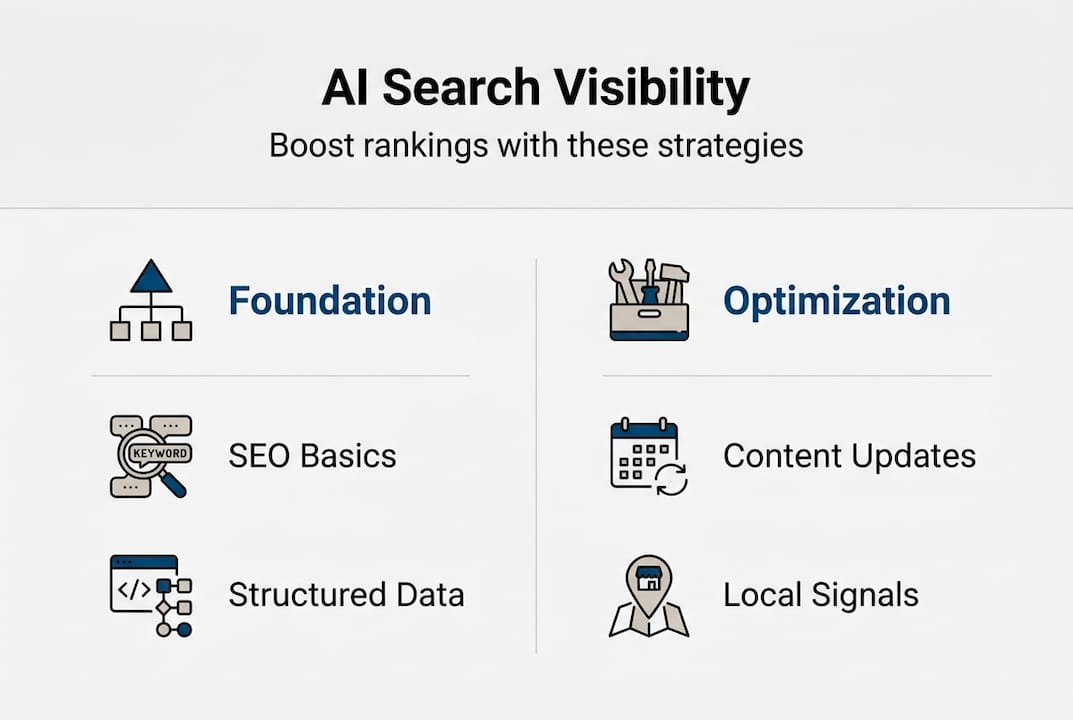
Generative Engine Optimization extends SEO specifically for AI platforms. While SEO focuses on ranking in traditional search results, GEO optimizes how AI engines extract and present your content in their responses. The key difference lies in content structure and presentation. AI systems prefer information formatted in easily digestible chunks like tables, bullet points, and clear question-and-answer formats. They also prioritize content with authoritative citations, statistics, and quotations from recognized experts.
Think of SEO as building the house and GEO as arranging the furniture for maximum functionality. You need both working together. Techniques that boost GEO effectiveness include:
- Creating comparison tables that AI can easily parse and present
- Structuring headings as direct questions users might ask
- Including verified statistics with proper citations
- Adding authoritative quotes from industry experts
- Implementing schema markup for enhanced data extraction
Pro Tip: Start by auditing your current SEO performance before adding GEO elements. A website ranking on page three won't benefit from GEO optimization because AI engines rarely pull from those lower positions.
The relationship between AI and SEO continues evolving, but the fundamental principle remains constant: quality content structured for both human readers and machine understanding wins. Overemphasizing GEO tactics while neglecting SEO basics creates an unstable foundation. Your content might look perfect for AI extraction but never reach the ranking threshold where AI engines consider it. Balance proves essential for sustainable visibility across all search platforms.
"Strong SEO forms the prerequisite for GEO success. Without ranking in traditional search, your perfectly optimized AI-friendly content remains invisible to generative engines."
Preparing your website: essential steps before AI optimization
Before diving into advanced optimization tactics, you need to establish a solid baseline. Start by conducting a comprehensive audit of your current SEO performance and content structure. Use Google Search Console to identify which pages already rank well and which topics generate the most impressions. This baseline data helps you measure the impact of your AI optimization efforts and identifies quick-win opportunities where small improvements could yield significant results.
Structured data implementation stands as a critical preparatory step. Schema markup helps AI engines understand your content context, business information, and the relationships between different page elements. Implement LocalBusiness schema for physical locations, FAQ schema for question-based content, and Article schema for blog posts. These structured data types make your content significantly easier for AI systems to parse and extract. Google's Structured Data Testing Tool lets you verify implementation before going live.
Content preparation requires gathering authoritative sources and statistics relevant to your industry. Research shows that adding statistics and citations improves AI visibility by 5.5% compared to single technique implementations. Create a reference library of credible sources you can cite in your content. Include industry reports, academic studies, and recognized expert opinions. AI engines prioritize content that demonstrates authority through proper attribution and factual backing.
Your local business presence needs attention across all platforms. Verify that your Name, Address, and Phone number remain consistent everywhere they appear online. This NAP consistency signals reliability to both traditional search engines and AI platforms. Claim and optimize your Google Business Profile, ensuring all categories, attributes, and business hours stay current. AI assistants frequently pull business information from these profiles when answering local queries.
Technical performance impacts AI visibility more than many businesses realize. Page speed, mobile responsiveness, and Core Web Vitals affect whether AI engines consider your content worthy of citation. Run your site through Google PageSpeed Insights and address any critical issues. Mobile optimization proves especially important as most AI assistant queries come from mobile devices. Users asking Siri or Google Assistant for recommendations expect fast, mobile-friendly experiences when they click through to your site.

Pro Tip: Create a spreadsheet tracking all your business listings across directories, social platforms, and review sites. Regular audits ensure consistency and help you quickly update information when details change. This preparation work prevents AI engines from citing outdated or conflicting information about your business.
Invest time in optimizing your marketing dollars by focusing on high-impact preparation activities. Many businesses rush into content creation without proper foundation work, wasting resources on optimization that cannot succeed without these prerequisites in place.
Executing AI search optimization: actionable strategies and techniques
Tables represent one of the most powerful tools for AI visibility. AI engines excel at extracting and presenting tabular data in their responses. Create comparison tables for products, services, pricing tiers, or feature sets. Format tables with clear headers and concise cell content. Avoid complex nested structures that confuse parsing algorithms. A simple three-column comparison table comparing your services often performs better than lengthy paragraphs explaining the same information.
Question-and-answer heading structures directly align with how users query AI assistants. Instead of generic headings like "Our Services," use specific questions your customers ask: "What does commercial HVAC maintenance include?" or "How much does website redesign cost for small businesses?" This format makes your content immediately extractable when AI engines encounter similar queries. Structure your content to provide direct, concise answers in the first paragraph under each question heading.
Research demonstrates that GEO techniques boost AI visibility by 30-40% when implemented correctly. The most effective approach combines multiple tactics:
- Add verified statistics with inline citations to support claims
- Include authoritative quotes from industry experts or studies
- Create comparison tables for products, services, or methodologies
- Structure content with question-based headings matching user intent
- Implement fluency optimization by writing clear, concise sentences
- Avoid keyword stuffing that triggers quality penalties
Keyword usage requires careful balance in the AI search era. While traditional SEO values keyword inclusion, over-optimization damages both traditional rankings and AI visibility. Focus on natural language and content fluency instead of forcing exact-match keywords into every paragraph. AI engines prioritize content that reads naturally and provides genuine value over content clearly written to manipulate rankings.
| Optimization Technique | AI Visibility Impact | Implementation Difficulty |
|---|---|---|
| Adding statistics with citations | +5.5% | Low |
| Creating comparison tables | +15-20% | Medium |
| Q&A heading structure | +10-15% | Low |
| Authoritative quotes | +8-12% | Medium |
| Fluency optimization | +5-8% | Low |
Local SEO signals carry significant weight for location-based AI queries. When users ask AI assistants for nearby services, the engines prioritize businesses with strong local signals. Maintain consistent NAP information across all platforms. Actively generate and respond to customer reviews on Google, Yelp, and industry-specific platforms. Review quantity, recency, and sentiment all factor into AI recommendation algorithms. A business with 50 recent positive reviews significantly outperforms competitors with older or fewer reviews.
Pro Tip: Create a monthly content calendar that includes updating existing high-performing pages with fresh statistics, new customer testimonials, and additional Q&A sections. This regular refresh signals to AI engines that your content remains current and authoritative.
Explore comprehensive generative engine optimization strategies that go beyond basic implementation. Advanced tactics include optimizing for specific AI platforms like ChatGPT, Perplexity, and Google's AI Overviews, each with unique content preferences and extraction patterns.
The secrets revealed in recent SEO studies emphasize the importance of E-E-A-T signals (Experience, Expertise, Authoritativeness, Trustworthiness) for AI visibility. Add author bios with credentials, link to authoritative external sources, and showcase genuine customer success stories. These trust signals help AI engines confidently cite your content over competitors lacking such validation.
Verifying and refining your AI search strategy for sustained success
Tracking AI-driven traffic requires different metrics than traditional SEO monitoring. Set up custom segments in Google Analytics isolating traffic from AI platforms and voice assistants. Monitor referral traffic from ChatGPT, Perplexity, and other AI engines. Track how this traffic behaves compared to traditional search visitors. You'll likely notice lower volume but higher engagement metrics like longer session duration and better conversion rates. These quality indicators justify continued investment in AI optimization even when traffic numbers seem modest.
Over-optimization presents a real risk that many businesses overlook. Excessive GEO tactics can damage traditional rankings, creating a net negative impact on overall visibility. Watch for warning signs like unnatural keyword density, too many bulleted lists disrupting content flow, or excessive quotations that make content feel disjointed. If you notice ranking drops after implementing GEO techniques, scale back and focus on natural, valuable content creation instead of manipulation tactics.
Platform-specific optimization becomes increasingly important as different AI engines show distinct preferences. Google's AI Overviews favor content with strong E-E-A-T signals and comprehensive coverage of topics. ChatGPT tends to cite sources with clear structure and authoritative backing. Perplexity emphasizes recent, well-cited content with specific data points. Bing's AI features prioritize content from sites with strong domain authority and extensive internal linking. Test your content across multiple platforms to identify which optimizations work best for each.
| Platform | Primary Ranking Factor | Content Preference | Update Frequency |
|---|---|---|---|
| Google AI Overviews | E-E-A-T signals | Comprehensive guides | Weekly |
| ChatGPT | Authoritative citations | Structured data | Monthly |
| Perplexity | Recent statistics | Specific facts | Bi-weekly |
| Bing AI | Domain authority | Detailed answers | Monthly |
Big brand bias affects AI search results significantly. Larger, more established brands receive preferential treatment in AI citations even when smaller businesses offer superior information. Combat this bias through earned media and genuine social proof. Pursue guest posting opportunities on authoritative industry sites. Seek mentions in local news outlets and trade publications. These third-party validations signal to AI engines that your business deserves consideration alongside bigger competitors.
Regular content audits identify opportunities for improvement and prevent optimization decay. Every quarter, review your top-performing pages and update them with:
- Fresh statistics and data points
- New customer testimonials and case studies
- Additional FAQ sections addressing emerging questions
- Updated comparison tables reflecting current market conditions
- New authoritative citations from recent studies
A/B testing different optimization approaches reveals what works best for your specific industry and audience. Try different heading structures, table formats, and citation styles. Monitor which variations generate more AI citations and featured snippet appearances. Document successful patterns and replicate them across other content. This iterative refinement process continuously improves your AI search performance over time.
Develop a comprehensive AI SEO customer acquisition strategy that integrates AI optimization with your broader marketing efforts. AI search should complement, not replace, your existing channels. The businesses seeing the best results treat AI optimization as one component of a holistic digital presence that includes traditional SEO, paid advertising, social media, and email marketing.
Unlock expert help to master AI search optimization
Navigating the complexities of AI search optimization while running your business creates significant time and expertise challenges. Our team specializes in helping small and medium businesses enhance their AI search visibility through proven SEO and GEO strategies. We handle the technical implementation, content optimization, and ongoing monitoring so you can focus on serving your customers. Our approach combines foundational search optimization with cutting-edge AI visibility techniques tailored to your specific market and competition.
Building strong local credibility through review generation and management amplifies your AI search presence significantly. We help you systematically collect authentic customer reviews, respond professionally to feedback, and leverage positive sentiment across all platforms. Our Yelp optimization services ensure your profile stands out in both traditional searches and AI recommendations. Combined with our professional website services, we create a comprehensive digital presence that dominates AI search results in your market. Partner with us to future-proof your online visibility and capture high-intent customers actively seeking your services through AI platforms.
Frequently asked questions
How can I tell if my website is optimized for AI search?
Check whether your site uses structured data markup by running it through Google's Rich Results Test. Review your content for Q&A formatted headings, comparison tables, and cited statistics. Monitor Google Search Console for featured snippet appearances, which indicate AI-friendly content structure. Track referral traffic from AI platforms in your analytics to measure actual AI visibility.
What are common mistakes to avoid when optimizing for AI search?
Avoid keyword stuffing and excessive use of bulleted lists or quotations that disrupt natural content flow. These tactics trigger quality penalties that harm both traditional and AI search rankings. Don't neglect foundational SEO elements like site speed, mobile optimization, and quality backlinks while chasing new GEO trends. Balance remains essential for sustainable results across all search platforms.
Should I focus more on local or national AI search optimization?
Your business model determines the right balance. Physical storefronts and service area businesses benefit most from intensive local optimization including Google Business Profile management and local review generation. E-commerce and national service providers should prioritize broader content strategies targeting informational queries. Most businesses achieve best results combining both approaches to capture opportunities at different stages of the customer journey.
How often should I update my content for AI search?
Refresh high-performing content monthly with new statistics, customer reviews, or FAQ additions to maintain AI relevance signals. Conduct comprehensive content audits quarterly to identify pages needing major updates. Monitor AI indexing trends in your industry and adjust your update frequency accordingly. Industries with rapid changes require more frequent updates than stable sectors. Consistency matters more than frequency for sustained AI visibility.
Recommended
- AEO vs GEO: How to Rank in AI Search & Google Overviews (2026)
- Top 3 GEO Strategies: Optimize for AI Search and Dominate LLM Visibility in 2025
- How to Get Found in AI Search: Secrets You Need Now
- Stop Chasing Clicks: How to Win 4.4x More Customers by Dominating AI Search
- AI in Local Ads Boost Your Service Business | Aim Set Win