

TL;DR:
- Getting your company listed in AI platforms involves legal registration, technical preparation, and targeted directory submissions. Building a systematic process, including automation and niche targeting, enhances visibility and buyer engagement. Consistent profile updates and collecting reviews further improve your ranking and credibility in AI search results.
Getting your company listed in AI platforms is defined as the process of submitting your business profile to AI-powered directories, startup databases, and specialized hubs where AI tools surface recommendations to buyers. This is the core strategy behind AI business visibility in 2026. Business owners who understand how to get a company listed in AI gain direct access to buyers who rely on tools like ChatGPT, Perplexity, and AI-curated directories to find vendors. The process combines legal compliance, structured data preparation, automated submissions, and niche targeting. Done right, it moves your company from invisible to recommended across AI-driven search and directory platforms simultaneously.
How to get a company listed in AI platforms: what you need to know first
Getting listed in AI platforms is not a single action. It is a coordinated, multi-channel process that spans legal registration, technical preparation, and targeted directory submissions. Business owners who treat it as a one-time form submission consistently underperform compared to those who build a repeatable system.
The foundation is legitimacy. AI directories and government-linked AI marketplaces require proof that your business is formally registered. In India, for example, AI companies must register formally as AI entities to access government marketplaces, and data breach penalties under the DPDP framework can reach 250 crore INR. That scale of risk makes compliance non-negotiable, not optional.
Beyond legal registration, the technical bar is rising. Platforms like Hugging Face require working, interactive product demos rather than static marketing pages. Over 300,000 active AI demos exist on Hugging Face Spaces as of 2026, and interactive models consistently attract higher engagement from enterprise buyers. A polished landing page is no longer enough.
Getting listed in AI platforms also requires selecting the right business activity codes during registration. Incorrect SSIC or MSIC codes in Singapore and Malaysia can disqualify your company from tax incentives and grants, sometimes requiring you to restart the entire application process. This is a technical detail with real financial consequences.
What prerequisites do you need before registering your business in AI?
Before you submit a single listing, three categories of preparation determine whether your efforts succeed or stall.
Legal and regulatory readiness
- Formal business registration in your operating region, with documentation that confirms your AI focus
- Correct business activity codes (SSIC in Singapore, MSIC in Malaysia, NIC codes in India) that classify your company accurately for government incentives
- Data privacy compliance relevant to your market, including DPDP in India, PDPA in Singapore, and GDPR if you serve European customers
- Proof of AI product deployment for advanced listings. Stock market listings on exchanges like China's STAR Market now mandate phased AI deployment evidence as of june 2026 guidelines
Technical assets required
- A working product demo or interactive prototype, not just a pitch deck
- Structured data markup (Schema.org) on your website so AI crawlers can read your business details accurately
- A consistent company description in multiple lengths: 50 words, 150 words, and 300 words for different directory formats
- High-resolution logo and product screenshots in standard web formats
Tools that accelerate the process
| Tool category | Primary use | Why it matters |
|---|---|---|
| AI submission pipelines | Automate directory submissions at scale | Reduces manual errors across 100+ platforms |
| Marketing automation platforms | Maintain listing consistency over time | Prevents outdated profiles from hurting credibility |
| Schema markup generators | Embed structured data on your website | Helps AI crawlers index your business correctly |
| Reputation management tools | Collect and display customer reviews | Reviews improve trust signals in AI directories |
Pro Tip: Build your company description in three lengths before you start submitting. Most directories have different character limits, and writing on the fly leads to inconsistent messaging that hurts brand recognition.
What are the steps to list your AI company on major directories?
Getting listed in AI platforms across 100+ directories requires a structured process. Skipping steps creates gaps that reduce discoverability.
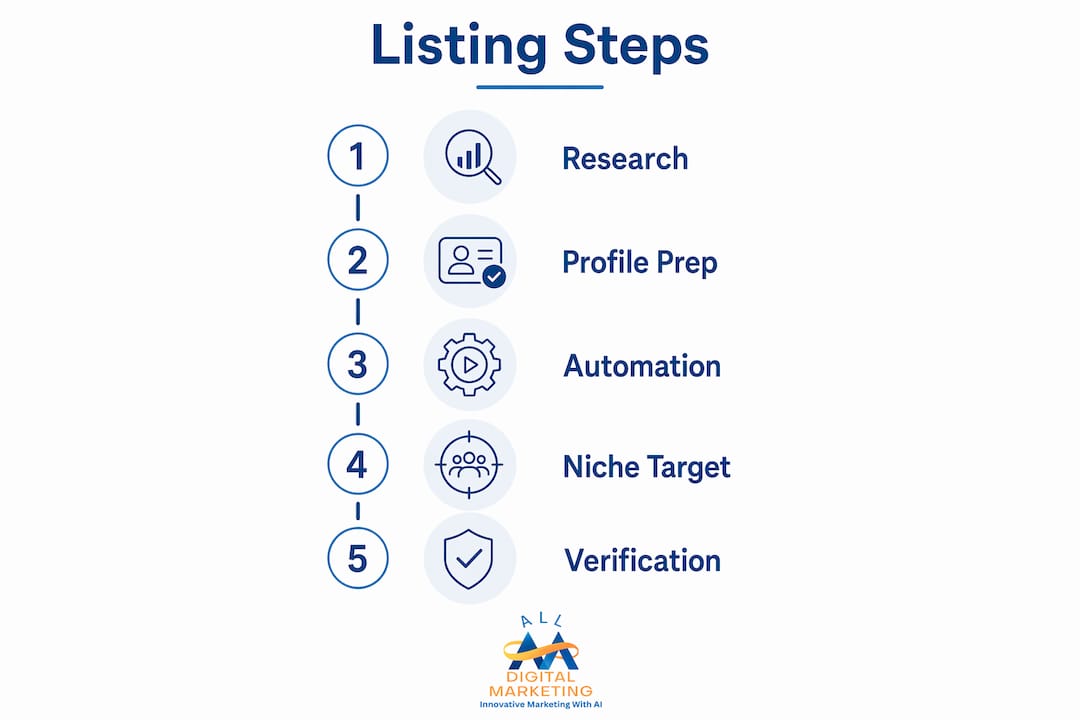
Step 1: Research and categorize your target platforms
Start by mapping directories into three tiers.
- General AI databases: broad platforms that list all AI companies regardless of industry
- Vertical-specific hubs: directories organized by industry such as healthcare AI, legal AI, or fintech AI
- Open-source and developer communities: platforms like Hugging Face, GitHub, and Product Hunt where technical buyers evaluate tools
More than 100 active AI directories and startup databases are tracked for automated submission pipelines in 2026. Targeting all three tiers is the difference between a narrow footprint and genuine market presence.
Step 2: Prepare tailored company profiles
Generic profiles perform poorly. Niche industry categorization in directories significantly improves visibility versus generic AI labels, according to AI directory curators. A company that labels itself "AI for dental practice management" will outperform one that simply says "AI software."
Your profile must include:
- A clear AI specialization statement (one sentence, no jargon)
- A working demo link or embedded prototype
- Customer use cases with measurable outcomes
- Verified contact information that matches your website
Step 3: Automate submissions with AI-agent pipelines
Manual submissions to 100+ directories are inefficient and error-prone. Automation pipelines using tools like Playwright generate 30 unique copy variations per product to avoid duplicate content penalties. This is not a shortcut. It is the only practical way to maintain consistency at scale without a dedicated team.

Step 4: Target niche industry directories for higher engagement
After covering general databases, shift focus to vertical directories. A healthcare AI company listed in a general directory competes with thousands of tools. The same company listed in a healthcare-specific AI hub reaches buyers who are already qualified. Specializing listings by user industry leads to higher discoverability and better matches with buyers.
Step 5: Verify and monitor all submitted profiles
After submission, confirm that each listing is live and accurate. Check for formatting errors, broken demo links, and outdated contact details. Set a calendar reminder to audit all listings every 90 days.
Pro Tip: Create a master spreadsheet tracking every directory you submit to, the date submitted, the status, and the login credentials. This single habit saves hours when you need to update your profile across dozens of platforms at once.
How do you maintain and optimize your AI listing for ongoing visibility?
Submitting your listing is the start, not the finish. AI directories reward active, updated profiles with higher placement. Static profiles lose ground to competitors who engage consistently.
The most direct way to maintain visibility is to respond to user feedback and reviews on every platform that allows it. Buyers read responses as a signal of company responsiveness. A company that answers questions and acknowledges feedback appears more credible than one with an untouched profile.
Synchronizing listings across all three directory tiers is equally important. Coordinated multi-platform listing strategies boost conversion rates from discovery to booked demos by 45% compared to single-platform launches. That number reflects what happens when buyers encounter your brand consistently across multiple touchpoints before making contact.
SEO plays a direct role in AI listing performance. Keyword targeting within your directory profiles, combined with content marketing on your own site, reinforces your authority in a specific niche. AI-powered marketing strategies for small and medium businesses in 2026 consistently show that content and directory presence work together, not separately.
Marketing automation platforms help maintain consistency without manual effort. Scheduling profile updates, review requests, and content refreshes through digital marketing automation tools prevents the drift that causes listings to become stale. Stale listings rank lower and convert less.
Pro Tip: Set a quarterly review cycle for all your AI directory profiles. Update your demo link, refresh your customer use cases, and add any new certifications or partnerships. Platforms that detect regular activity tend to surface active profiles more frequently in search results.
What are the common mistakes when getting listed in AI platforms?
Most listing failures trace back to a small set of repeatable errors. Knowing them in advance saves significant time and money.
- Selecting the wrong business activity codes: This is the most costly mistake for companies operating in regulated markets. Incorrect codes delay access to government incentives and may require restarting the registration process entirely. In Singapore and Malaysia, SSIC and MSIC codes directly determine grant eligibility.
- Relying on manual bulk submissions: Submitting to 100+ directories by hand produces inconsistent profiles, duplicate content flags, and login credential chaos. Automation pipelines exist precisely because manual processes fail at scale.
- Publishing static profiles on demo-centric platforms: Platforms like Hugging Face are built for interactive engagement. A static marketing page on a platform that expects a working model signals to technical buyers that your product is not ready.
- Underestimating regulatory timelines: In Malaysia, coordination across agencies like MDEC and SSM adds 2–3 months to setup timelines. Companies that start the listing process before completing registration often waste submissions on profiles they cannot verify.
- Ignoring niche directories in favor of general ones: General AI directories generate broad exposure but low conversion. Niche directories generate fewer impressions but far higher buyer intent.
The most expensive mistake is treating AI platform listing as a marketing task rather than a compliance and technical process. Companies that skip the legal and structural groundwork spend months fixing errors that could have been avoided in the first week.
Building brand authority in AI-driven search requires getting the fundamentals right before scaling outreach. Visibility built on a weak foundation collapses when platforms audit listings for accuracy.
Key Takeaways
Getting listed in AI platforms requires legal compliance, technical preparation, automated submissions, and niche directory targeting to produce lasting visibility and qualified buyer engagement.
| Point | Details |
|---|---|
| Legal registration comes first | Correct business activity codes determine grant eligibility and prevent costly restarts. |
| Automate directory submissions | AI-agent pipelines generate unique copy variations and reduce errors across 100+ platforms. |
| Target niche directories | Industry-specific listings outperform generic AI labels in discoverability and buyer match quality. |
| Maintain active profiles | Coordinated multi-platform updates boost demo conversion rates by 45% versus single-platform efforts. |
| Plan for regulatory delays | Markets like Malaysia add 2–3 months to timelines; early preparation prevents launch delays. |
What I've learned about AI listing after working with dozens of companies
The pattern I see most often is this: a business owner spends weeks crafting a perfect company profile, submits it to three or four general directories, and then wonders why nothing happens. The profile is fine. The strategy is the problem.
The companies that gain real traction from AI platform listings are the ones that treat it as a system, not a task. They start with compliance, build their technical assets before submitting anywhere, and then use automation to cover the full directory landscape. They also pick a niche and commit to it. A company that says "we serve healthcare AI buyers" will always outperform one that says "we serve everyone."
What surprises most business owners is how much reviews matter inside AI directories. Platforms that surface vendor recommendations to buyers use review signals as a trust filter. A company with ten detailed, verified reviews ranks above a company with a better product and no reviews. This is not fair. It is just how the systems work.
My honest recommendation is to start the regulatory and compliance work at least three months before you plan to go live with listings. The technical and marketing work can happen in parallel, but the legal foundation cannot be rushed. Companies that skip this step spend more time fixing problems than they would have spent doing it right the first time.
The social media and SEO connection to AI listing performance is also underestimated. Active social profiles and consistent content publication reinforce your authority signals across the platforms that AI tools use to evaluate credibility. Listing and content are not separate strategies. They feed each other.
— Diane
How Digitalmarketingall supports your AI platform visibility
Your AI directory listings are only as strong as the reputation behind them. Buyers who find your company in an AI-curated directory will immediately check your reviews before making contact. Digitalmarketingall's review generation and management service builds the review foundation that makes your listings convert. The service handles review collection, monitoring, and response management so your profiles stay credible and current. Strong reviews improve your ranking inside AI directories and increase the trust signals that AI recommendation engines use to surface your business. If you want your listing to do more than exist, your reputation needs to back it up. Visit Digitalmarketingall to see how customer review management fits into a complete AI visibility strategy.
FAQ
What does it mean to get a company listed in AI?
Getting listed in AI means submitting your business profile to AI-powered directories, startup databases, and specialized hubs where AI tools surface vendor recommendations to buyers. It combines legal registration, structured data, and targeted directory submissions.
How many AI directories should I submit my company to?
More than 100 active AI directories and startup databases are tracked for automated submission pipelines in 2026. Targeting all three tiers, general databases, vertical hubs, and developer communities, produces the broadest and most qualified reach.
How long does the AI company registration process take?
Timeline depends on your region. In Malaysia, coordination across agencies like MDEC and SSM adds 2–3 months to official setup timelines. Starting compliance and registration work at least three months before your planned listing date prevents delays.
Why do niche directories outperform general AI directories?
Niche directories attract buyers with specific needs who are already qualified for your product. Specializing listings by user industry leads to higher discoverability and better buyer matches compared to generic AI labels in broad directories.
Do I need a working product demo to get listed?
On platforms like Hugging Face, yes. Over 300,000 active AI demos exist on Hugging Face Spaces, and interactive models consistently generate higher engagement from technical and enterprise buyers than static marketing pages.