

TL;DR:
- Dominating search suggestions allows brands to capture user intent at its earliest point before query completion.
- Effective strategies include optimizing local data hygiene, structured content, schema markup, and conversational long-tail keywords.
Most businesses focus on ranking for keywords they already know. But the real opportunity sits one step earlier: the moment a potential customer starts typing and Google finishes their sentence for them. Learning how to dominate search suggestions is one of the highest-leverage visibility plays available to digital marketers and small business owners today. When your brand appears before a user even completes their query, you capture intent at its rawest point. This article walks you through exactly what it takes to claim that position, from foundational setup to advanced local SEO tactics and AI-driven content strategies.
Table of Contents
- Key takeaways
- How to dominate search suggestions: what you need before you start
- Optimizing content and site structure for autocomplete
- Advanced local SEO for search suggestion visibility
- Common mistakes that undermine search suggestion dominance
- Verifying success and measuring your search suggestion impact
- My perspective on mastering search suggestion dominance
- Ready to amplify your search visibility?
- FAQ
Key takeaways
| Point | Details |
|---|---|
| Autocomplete is dynamic | Search suggestions are ranked in real time using volume, trends, and context, so your strategy must be equally adaptive. |
| Content structure drives AI visibility | Pages with 120 to 180 word sections earn significantly more AI citations and search suggestion placements. |
| Local data hygiene is non-negotiable | Consistent NAP data combined with schema markup delivers measurable lifts in AI-powered local search suggestions. |
| Review quality outweighs quantity | Detailed, specific reviews signal far more to AI search systems than a high star count alone. |
| Ethical optimization wins long-term | Sustainable search suggestion dominance comes from genuine value creation, not manipulative or shortcut tactics. |
How to dominate search suggestions: what you need before you start
Before you write a single piece of content or touch your business profile, you need to understand what you are actually optimizing for. Google's autocomplete suggestions are dynamically generated in real time based on search volume, trending queries, user personalization, and contextual relevance. That means suggestion dominance is not a one-time fix. It is an ongoing ranking challenge with multiple variables moving simultaneously.
The knowledge you need first
Start by studying how autocomplete pulls data. Suggestions are built around query prefixes. When someone types "plumber in," the algorithm predicts the most statistically likely completions based on what people in that area are searching for. Your job is to create the strongest possible signal that your brand or service is the natural completion for those high-value prefixes.
Keyword research for search suggestions works differently than standard SEO keyword research. You are not just targeting finished queries. You are targeting the partial inputs that lead to finished queries. Focus on:
- Prefix variations like "best [service] in [city]," "affordable [service] near me," and "[service] for [specific need]"
- Long-tail conversational queries that mirror how people speak, not just how they type
- Local modifiers including neighborhood names, landmarks, and city districts
- FAQ-style question starters like "how do I find," "what is the best," and "where can I get"
Tools and data sources
You cannot optimize what you cannot measure. Use Google Search Console to identify existing queries triggering impressions. Use tools like keyword research platforms, autocomplete scrapers, and local rank trackers to map the prefix landscape for your niche and location. Google Trends is also underutilized here. It shows which partial queries are accelerating in your market right now.
Here is a foundational prerequisite overview before launching any search suggestion campaign:
| Prerequisite | Why it matters | Tool or resource |
|---|---|---|
| Claimed Google Business Profile | Required for local pack and local suggestion visibility | Google Business Profile |
| NAP consistency audit | Inconsistent data confuses AI entity recognition | Moz Local, BrightLocal |
| Keyword prefix map | Identifies which partial queries to target with content | Ahrefs, SEMrush, manual autocomplete |
| Schema markup implementation | Amplifies AI extraction and structured data signals | Google's Schema Markup Validator |
| Content calendar aligned to queries | Ensures consistent topical coverage of high-value prefixes | Editorial planning tools |
Getting these five foundations in place before you execute saves significant rework later. Digital marketers who skip this preparation phase often wonder why their content efforts do not translate into search suggestion visibility. The answer is almost always that the ground was not prepared.
Optimizing content and site structure for autocomplete
Once your foundation is solid, execution comes down to content creation and site architecture. This is where small businesses targeting conversational keywords and structured content formats consistently outrank larger competitors who rely on generic homepage SEO.
Follow these steps to build a content system that captures autocomplete completions:
-
Map your target prefix queries. Extract autocomplete data for your core service and location combinations. Build a spreadsheet that logs every relevant partial query and the top suggestion completions for each. This becomes your content targeting map. You can learn more about this approach in this autocomplete marketing guide for small businesses.
-
Build dedicated content clusters. Each high-value prefix query should have its own dedicated page or post, not a generic paragraph buried in your homepage. If "emergency HVAC repair Austin" is a target prefix, you need a page that speaks directly to that query, with a URL, title tag, and H1 that reflect the phrase naturally.
-
Implement schema markup. Use "LocalBusiness
,FAQPage, andService` schema types wherever applicable. Schema markup combined with NAP consistency has been shown to deliver a roughly 2.4x AI visibility lift in local search suggestions, making structured data one of the highest-return technical investments you can make. -
Format content for AI extraction. Pages structured into 120 to 180 word sections earn 70% more AI citations than pages with shorter sections, and total content length over 2,900 words significantly increases AI citation likelihood. Write in short paragraphs. Use descriptive subheadings. Include bulleted summaries for complex points. AI systems favor content that is already organized and easy to extract.
-
Use conversational long-tail keywords throughout. Incorporate query-style language in your title tags, meta descriptions, URL slugs, and body copy. A page titled "Best Pediatric Dentist in Denver: What Parents Ask Most" performs better in suggestion contexts than "Denver Pediatric Dentistry Services."
-
Support text with multimedia. Optimized images with descriptive alt text, short explainer videos, and embedded maps all contribute to richer search snippets and stronger engagement signals. These signals feed back into suggestion ranking over time.
Pro Tip: Never attempt to artificially inflate search volumes for a query prefix to force your way into autocomplete. This tactic violates Google's policies and frequently triggers penalties. Sustainable visibility in search suggestions comes from genuine authority and real content value, not manipulation.
Advanced local SEO for search suggestion visibility
Local search suggestions and the local pack are powered by a distinct set of signals beyond standard on-page SEO. If you serve a geographic area, these tactics directly affect your ability to appear in location-sensitive suggestions like "best accountant near me" or "top-rated roofer in [city]."
Claiming and verifying your Google Business Profile is the single most important first step for local suggestion visibility. A fully completed profile, with accurate categories, updated service areas, current hours, photos, and active posts, tells Google's local algorithm that your business is active, legitimate, and relevant.
Beyond basic profile completion, here are the signals that separate average local visibility from true search suggestion dominance:
- Category selection: Choose your primary category with precision. Secondary categories should reflect actual services, not keyword stuffing attempts.
- Review management: Review content quality correlates about 6x stronger with AI visibility than review count alone. Encourage customers to leave detailed, specific reviews that mention your service, location, and the outcome they experienced.
- Q&A section: Populate your Google Business Profile's Q&A section with common questions and thorough answers. This content feeds directly into search suggestion contexts.
- Posts and updates: Publish weekly posts covering promotions, service updates, or local news relevant to your business. Active profiles rank higher in local packs and suggestion contexts.
- Directory consistency: Your name, address, and phone number must be identical across every directory listing. Inconsistencies degrade entity confidence in AI-powered local search.
The table below shows how traditional local SEO tactics compare to AI-focused local SEO enhancements:
| Tactic | Standard local SEO approach | AI-enhanced local SEO approach |
|---|---|---|
| Google Business Profile | Claim and complete basic info | Full completion with posts, Q&A, photos, and schema |
| Reviews | Maximize star rating volume | Encourage detailed, specific review narratives |
| NAP consistency | Match across major directories | Audit all citations plus add structured data markup |
| Content strategy | Location pages with service info | Conversational query clusters targeting prefix intent |
| Link building | General authority links | Locally relevant links from neighborhood sites and press |
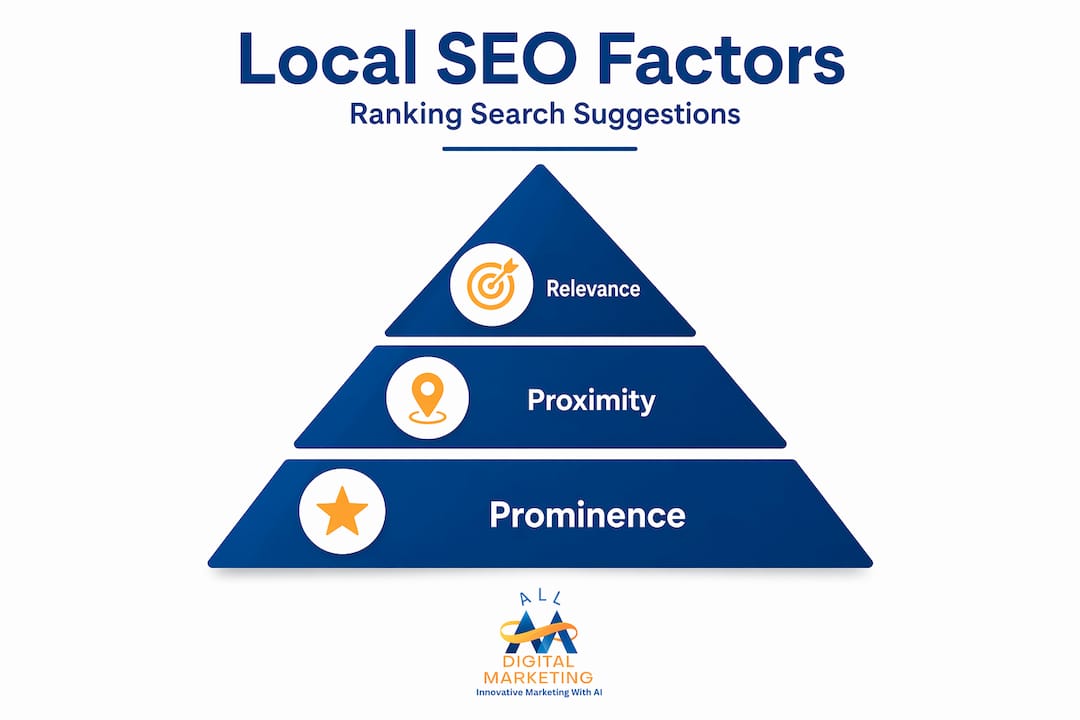
Local pack rankings are governed by three factors: relevance, proximity, and prominence. You can influence all three. Relevance comes from category accuracy and content alignment. Prominence grows through reviews, links, and content authority. Proximity is fixed, but you can optimize your service area descriptions to appear in suggestions across a wider geographic radius. For deeper tactics on this, explore this local business search ranking guide covering both SEO and AI visibility strategies.
Common mistakes that undermine search suggestion dominance
Knowing what not to do is just as valuable as knowing what to do. Many businesses spend months executing the right tactics but see limited results because a few critical errors are canceling out their progress.
Here are the most common pitfalls and how to address each one:
-
Keyword over-optimization: Cramming target phrases into content unnaturally triggers low-quality signals. Google's systems recognize this pattern and discount the page's suggestion relevance. Write for the reader first and let keyword alignment happen naturally through thorough topic coverage.
-
NAP inconsistencies: If your business address differs between your website, Google Business Profile, and Yelp, AI systems lose confidence in your entity data. NAP inconsistencies degrade entity confidence specifically in AI and local search contexts. Audit all citations and fix discrepancies before doing anything else.
-
Thin or fragmented content: A page with 200 words on a high-value service cannot compete for AI citation or autocomplete suggestion placements. Content needs genuine depth, organized structure, and query-matched language to show up where it counts.
-
Neglecting profile and review management: A stale Google Business Profile or an unanswered negative review sends negative signals to both users and search algorithms. Treat your profile like a live marketing asset, not a set-it-and-forget-it form.
-
Using black-hat autocomplete tactics: Artificially inflating search query volumes through bots or click farms to influence suggestions is a high-risk strategy. Manipulative autocomplete tactics may lead to search penalties and undermine all your legitimate work. The long-term cost is never worth it.
Pro Tip: Test your target prefix queries directly in an incognito browser window from a location close to your service area. This gives you an unbiased, real-time view of what suggestions are actually appearing for those queries and where your brand currently stands.
Verifying success and measuring your search suggestion impact
You cannot manage what you do not measure. Once your strategies are live, set up a structured monitoring system to track progress and identify where to iterate.
Follow this process to verify your search suggestion performance:
-
Monitor autocomplete rankings. Use autocomplete scraping tools or manual tracking to record which suggestion positions your brand appears in for target prefix queries. Log these weekly and track movement over time.
-
Analyze traffic from suggestion-driven queries. In Google Search Console, filter impressions and clicks by query to identify which partial queries are driving traffic. A spike in clicks from prefix-style queries is a strong indicator that your suggestion visibility is growing.
-
Track local pack visibility. Tools like BrightLocal or Whitespark track your local pack rankings across different geographic points in your service area. Pair this with direct search testing.
-
Review Google Business Profile insights. Check the "Searches" section inside your profile dashboard regularly. It shows the exact queries people used to find your profile, which directly reflects your local suggestion relevance.
-
Set up review alerts. Use Google Alerts or a dedicated review monitoring tool to get notified of new reviews across platforms. Respond to every review, both positive and negative, within 24 to 48 hours.
Here is a metrics tracking framework to use on a monthly basis:
| Metric | What it tells you | Recommended tool |
|---|---|---|
| Autocomplete suggestion position | Direct measurement of suggestion dominance | Manual testing, autocomplete scrapers |
| Search Console query impressions | Which prefix queries Google is showing your content for | Google Search Console |
| Local pack rank by location | Visibility in map-based local suggestions | BrightLocal, Whitespark |
| GBP profile views and clicks | How often your profile appears in local search | Google Business Profile Insights |
| Review volume and sentiment | Trust signals affecting suggestion ranking | Google Alerts, review management tools |
Treat this data as a feedback loop. If a content cluster is earning impressions but not clicks, revisit your title tag and meta description. If local pack rankings plateau, look for NAP inconsistencies or thin review narratives. Optimization based on real data moves faster than guesswork.
My perspective on mastering search suggestion dominance
I've worked with enough businesses over the years to know that the ones who obsess over search suggestion rankings often miss the point. The businesses that actually dominate suggestions long-term are not the ones who find the most clever optimization tricks. They are the ones that consistently produce content that genuinely answers what their customers are asking.
What I've seen backfire most often is the chase for clicks without a foundation of real value. Marketers optimize title tags, stuff location modifiers into every sentence, and wonder why Google's AI systems pass them over. The answer is usually that the content underneath does not hold up. Google rewards content that fulfills people's needs in ways that go beyond surface-level keyword matching.
The part that surprises most small business owners is how much local data hygiene actually matters. Fixing a mismatched suite number across three directory listings sounds boring. But in my experience, that kind of cleanup often produces more measurable lift in local suggestion visibility than a month of content publishing. You cannot ignore the fundamentals and expect tactics to carry you.
I've also noticed that the shift toward AI-powered search is changing what "ranking" means. It is no longer just about position one on a results page. It is about whether your content gets extracted and surfaced inside an AI overview, a local answer card, or an autocomplete suggestion before the user even hits search. That requires structured, thorough, and author-attributed content written with genuine intent.
My recommendation: stay adaptable. The algorithms will keep changing. What will not change is that useful, well-organized, locally relevant content earns its place at the top. Build that, maintain it, and the suggestions will follow.
— Diane
Ready to amplify your search visibility?
If you've made it this far, you know that search suggestion dominance requires more than publishing a few blog posts. One of the most underleveraged tools in your local SEO arsenal is also one of the most direct trust signals available: your online reviews. Detailed, location-specific, service-focused reviews feed AI search systems the exact signals they need to surface your business in suggestion results and local packs.
Digitalmarketingall offers professional review generation and management services designed specifically to help local businesses earn the kind of high-quality, detailed reviews that improve search suggestion rankings and local pack visibility. Beyond reviews, explore the full library of local SEO and AI search guides on the site, including this resource on AI search strategies for 2025 and beyond, to keep building your visibility across every channel that matters.
FAQ
What are search suggestions and why do they matter?
Search suggestions, also called autocomplete results, are the query completions that appear as you type in a search bar. They represent high-intent traffic opportunities because they capture users at the earliest stage of their search behavior.
How long does it take to appear in autocomplete suggestions?
There is no fixed timeline, but businesses that publish consistent, query-aligned content and maintain fully optimized local profiles typically begin seeing measurable autocomplete visibility within 60 to 90 days of sustained effort.
Does review quality really affect search suggestions?
Yes. Review content quality correlates about 6x stronger with AI-powered local search visibility than star rating volume alone. Detailed reviews that reference specific services and locations produce stronger search signals.
Can small businesses compete with large brands in search suggestions?
Absolutely. Local search suggestions are inherently geographic, which means a well-optimized local business can outperform a national brand for location-specific prefix queries by focusing on conversational keywords and structured content that large brands often overlook.
What is the fastest fix for poor local search suggestion visibility?
Audit your NAP consistency across all directories and fix any discrepancies first. Inconsistent business data is the most common and most fixable reason for low entity confidence in AI-powered local search systems.