

TL;DR:
- Email marketing can replace a significant portion of PPC spend for small businesses when a strong owned list is built and automated systems are implemented. The process requires careful phase-based development, from list growth to automation, with measurable KPIs and strict deliverability practices a focus. Proper timing and testing are essential to reduce PPC without risking lost revenue or pipeline disruption.
For many small businesses, email marketing can replace a substantial share of ongoing PPC spend — but only when you build it the right way. The three-step path is straightforward: grow an owned list, automate high-context nurture and conversion flows, and protect deliverability while measuring pipeline influence. Most teams see meaningful PPC reduction within several months of starting this program.
Here is what to do this week: launch one list-building ad that drives traffic to a lead magnet landing page, set up a 3-email welcome sequence, and configure SPF, DKIM, and DMARC on your sending domain. Those three actions start the clock.
The economics make the case clearly. Email marketing delivers $36–$42 in return for every $1 spent, compared to roughly $2 for PPC. That gap compounds over time because your list is an owned asset. When you stop paying for ads, the list keeps working. When you stop paying for ads, the traffic stops.
Table of Contents
- Can You Build Email Marketing to Replace PPC?
- Step-by-Step Roadmap: Build Your List, Automate Nurture, and Optimize
- How to Grow Your List Fast Enough to Replace PPC Lead Flow
- Automation, Segmentation, and Personalization: Your Conversion Engine
- Deliverability, Infrastructure, and Legal Must-Dos for U.S. Businesses
- How to Measure Success, Set KPIs, and Run the Cost Math
- How to Phase Down PPC Spend Without Killing Acquisition
- Common Mistakes That Cause Email Programs to Fail as a PPC Replacement
- How Digital Marketing All Builds an Email-First Program
- Key Takeaways
- What Working With SMBs on This Transition Has Taught Me
- Digital Marketing All Helps You Build an Email Program That Reduces Ad Spend
- Useful Sources and Further Reading
- FAQ
Can You Build Email Marketing to Replace PPC?
Yes, with one important condition: email replaces the ongoing cost of paid acquisition, not the initial list-building phase. PPC and email serve different roles in the customer journey. PPC drives awareness and pulls in new prospects who have never heard of you. Email converts, retains, and monetizes the audience you have already captured.
The channel economics tell the story directly: paid ads are rented attention that stops producing the moment spend stops, while a well-maintained list compounds in value with every new subscriber and every automated sequence you add.
When email can fully replace a large share of PPC:
- Your list has at least a few thousand permissioned, engaged subscribers
- You sell a product or service with a predictable repurchase cycle or high lifetime value
- Your sales cycle is long enough that nurture emails can move prospects through the funnel
- You have behavioral data (site visits, downloads, pricing page views) to trigger relevant follow-ups
When email cannot replace PPC yet:
- You are a brand-new business with no list and no organic traffic
- Your product has a one-time, impulse-purchase dynamic with no logical follow-up
- You need immediate revenue and cannot wait 5–12 months for list-based ROI to materialize
The smart early-stage move is to use PPC strategically to seed list growth, then shift budget toward email-driven retention as the list matures. PPC and email are partners first, and substitutes second.
Step-by-Step Roadmap: Build Your List, Automate Nurture, and Optimize
A phased approach reduces risk and gives you clear decision points before you cut any ad spend.

| Phase | Timeline | Primary Goal | Key Milestone |
|---|---|---|---|
| Phase 1: Build the Foundation | Early months | Capture and validate leads; authenticate domain | Initial double opt-in subscribers; SPF/DKIM/DMARC live; welcome sequence running |
| Phase 2: Automate and Test | Following months | Behavioral triggers, segmentation, small PPC experiments | Target click-to-open rate above a specified threshold; first email-influenced pipeline deals tracked |
| Phase 3: Scale and Reallocate | Later months | Scale personalization; shift PPC budget to email-driven segments | Gradual reduction in prospecting PPC; email-influenced revenue tracked in CRM |
Phase 1 priorities (months 0–3):
- Set up domain authentication (SPF, DKIM, DMARC) before sending a single campaign
- Begin a multi-week domain warm-up with low-volume sends to your most engaged contacts
- Create one high-value lead magnet and build a dedicated landing page
- Write a 3–5 email welcome sequence that delivers on the lead magnet promise and introduces your offer
- Establish UTM tagging so every subscriber source is tracked in your CRM
Phase 2 priorities (months 3–6):
- Add behavioral triggers such as pricing page visits, content downloads, and webinar attendance
- Segment your list by intent and lifecycle stage (at minimum: new leads, active prospects, past customers)
- Run a controlled experiment: pause PPC on one high-LTV segment and measure whether email-driven revenue holds
- Track click-to-open rate (CTOR) and reply rate, not just open rate
Phase 3 priorities (months 6–12):
- Expand personalization using industry, company stage, and recent behavior
- Attribute pipeline-influenced revenue to email in your CRM
- Apply the reallocation rule: reduce prospecting PPC gradually only after email sequences consistently hit healthy engagement metrics such as strong click-to-open and reply rates
How to Grow Your List Fast Enough to Replace PPC Lead Flow
List growth is the rate-limiting step. If your list grows slowly, the transition takes longer. These tactics accelerate acquisition without simply spending more on ads.
Organic and owned tactics:
- Gated content: Checklists, calculators, templates, and short video series work well for SMB audiences. A tax-savings calculator for an accounting firm or a pricing guide for a contractor converts at a higher rate than a generic newsletter signup.
- Content upgrades: Embed a relevant download inside a blog post that already ranks. A reader who finds your post on Google and downloads your checklist is a warm, qualified lead.
- SEO-led capture: Content-driven list growth compounds over time. A single well-ranked post can generate opt-ins for years at zero marginal cost.
- Referral programs: Offer existing subscribers a bonus for referring a colleague. B2B referrals tend to produce high-quality leads because the referrer pre-qualifies them.
Paid-to-list tactics (reallocating PPC spend):
Instead of running ads directly to a sales page, run them to a lead magnet landing page. The goal shifts from immediate conversion to list opt-in. This costs more per lead upfront but produces an owned asset rather than a one-time click. Once a subscriber is in your sequence, the marginal cost of future touchpoints drops to near zero.
Partnerships and offline capture:
Trade show badge scans, retail receipt QR codes, and co-marketing swaps with complementary businesses all generate high-quality opt-ins because the prospect already has context about who you are. A co-marketing email swap with a non-competing business in your industry can add hundreds of targeted subscribers in a single send.
Best-practice checklist for every tactic:
- Always use explicit consent language at the point of capture ("I agree to receive marketing emails")
- Use double opt-in to confirm addresses and protect sender reputation
- Validate email addresses at the form level to catch typos before they enter your list
- Set a clear expectation at signup: what you will send and how often
Pro Tip: Place your opt-in form above the fold on your homepage, as a timed pop-up (30–60 seconds or exit intent), and embedded mid-content in your top blog posts. The footer is the last place a motivated subscriber looks.
Automation, Segmentation, and Personalization: Your Conversion Engine
A list without automation is just a broadcast channel. The revenue comes from behavioral triggers and lifecycle flows that treat email as a system, not a monthly newsletter.
Building your segmentation matrix
Start with 3–5 segments before adding complexity. A practical starting matrix for most SMBs:
- New leads (days 0–14): In welcome sequence; goal is to deliver lead magnet value and introduce your offer
- Active prospects (engaged in last 30 days): Receiving nurture content; watch for behavioral signals
- High-intent prospects: Visited pricing page, downloaded multiple assets, or attended a webinar
- Past customers: Eligible for expansion, upsell, and referral sequences
- Inactive subscribers (60+ days no engagement): Candidates for re-engagement sequence before suppression
Sample lead-magnet-to-demo email sequence
- Email 1 (immediate): Deliver the lead magnet. One link, one CTA. No selling.
- Email 2 (day 2): One practical tip that extends the lead magnet value. Soft mention of how you help.
- Email 3 (day 4): A short case result or outcome story. CTA to read more or book a call.
- Email 4 (day 7): Address the most common objection your prospects have. Direct CTA to schedule a demo.
- Email 5 (day 10): Last-chance framing. Ask if they are still interested. Keep it honest and brief.
- Email 6 (day 14): Move to nurture cadence if no response. No hard sell.
Behavioral triggers that change messaging
Behavioral intent signals like pricing page visits, repeat content downloads, and webinar attendance tell you a prospect is moving toward a decision. When someone visits your pricing page twice in a week, that is not the moment to send a generic newsletter. It is the moment to send a short, direct email offering a 15-minute call. Connecting these triggers to your CRM means your sales team sees the signal too.
AI-assisted personalization makes this scalable for small teams. Dynamic content blocks that swap based on industry or company stage, AI-generated subject line variants, and automated reply prioritization all reduce the manual workload while improving relevance. Personalization that uses buyer context — industry, company stage, recent behavior — significantly outperforms first-name tokens alone.
Pro Tip: Early-stage outreach to cold or warm leads almost always performs better as plain text. HTML templates with logos and banners signal "marketing email." A plain-text message from a real person signals "this is worth reading." Save HTML for newsletters and promotional campaigns to engaged lists.
Deliverability, Infrastructure, and Legal Must-Dos for U.S. Businesses
Deliverability is the foundation. An email program that lands in spam does not replace PPC. It replaces nothing.
Authentication checklist:
- SPF: Publish a Sender Policy Framework record in your DNS to authorize your sending server
- DKIM: Add a DomainKeys Identified Mail signature so receiving servers can verify your messages are unaltered
- DMARC: Start with
p=noneto monitor, move top=quarantineafter 30 days of clean data, thenp=rejectonce you are confident in your sending infrastructure - Custom sending domain: Never send from a free Gmail or Yahoo address for business campaigns
Domain warm-up: New domains require a gradual warming period over several weeks. Start with low volume sends to your most engaged contacts, gradually increasing volume while monitoring bounce and complaint rates carefully. Skipping this process causes inbox placement penalties that can take months to reverse.
List hygiene practices:
- Use double opt-in to confirm every new subscriber and eliminate typo addresses
- Run quarterly list cleanups: suppress anyone who has not opened or clicked in 90 days
- Keep spam complaint rate below 0.1% and bounce rate below 2%
- Remove hard bounces immediately after they occur
CAN-SPAM basics for U.S. businesses:
Every commercial email must include your physical mailing address, an accurate "From" name, a non-deceptive subject line, and a working unsubscribe link. Honor unsubscribe requests within 10 business days. This is general information, not legal advice; confirm current requirements with a qualified attorney for your specific situation.
Deliverability monitoring: Use an inbox placement testing tool (GlockApps, MXToolbox, or your ESP's built-in tools) to check where your messages land before scaling volume. Check your Google Postmaster Tools dashboard weekly once you are sending to Gmail addresses at scale.
Pro Tip: A spam complaint rate above 0.1% is a warning sign. Above 0.3%, you are actively damaging your sender reputation. If you hit 0.3%, pause sends immediately, clean your list, and reduce frequency before resuming.
How to Measure Success, Set KPIs, and Run the Cost Math
Open rates are no longer a reliable primary metric. Apple Mail Privacy Protection inflates open data, so many teams now prioritize click-through rate and CTOR as primary engagement signals.
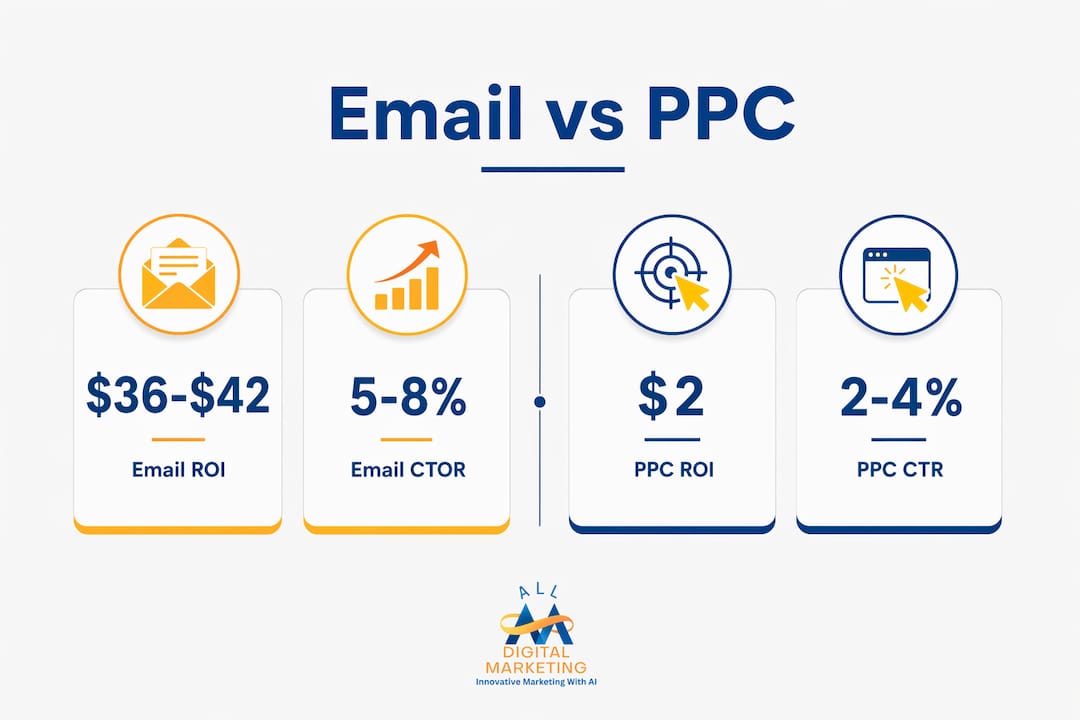
| KPI | Target Benchmark | Why It Matters |
|---|---|---|
| Click-through rate (CTR) | 2–4% for B2B | Measures actual content engagement |
| Click-to-open rate (CTOR) | Above 5–8% | Shows relevance to openers |
| Reply rate | Above 1–2% | Signals high-intent prospects |
| Inbox placement | Above 90% | Confirms deliverability health |
| Pipeline-influenced revenue | Track in CRM | Connects email to business outcomes |
| Blended CAC | Compare monthly | Shows cost reduction vs. PPC-only baseline |
Sample cost math:
Assume you currently spend $5,000/month on PPC to generate 50 leads at $100 CAC. You add $1,500/month in email program costs (ESP, content, and light automation setup). Over six months, your list grows to 3,000 subscribers. Your email sequences generate 20 additional leads per month at roughly $75 each (total email cost divided by leads attributed). Your blended CAC drops from $100 to approximately $89, and the email-generated leads cost less with each passing month as your list grows and your sequences are already built.
Timeline expectations:
- Month 3: Deliverability stable, welcome sequence running, first CTOR data available
- Month 6: Behavioral triggers live, first email-influenced pipeline deals visible in CRM
- Month 12: Email-driven leads covering 20–40% of total acquisition; PPC budget reallocated accordingly
Budget checklist:
- ESP and automation platform: $50–$500/month depending on list size and features
- Content production (copywriting, design): $500–$2,000/month
- Deliverability tooling: $50–$150/month
- Staffing or agency management: variable
Decision rule for reallocation: Do not cut PPC until email sequences have run for at least 60 days on a segment of at least 500 subscribers, CTOR is consistently above 5%, and you can attribute at least 10 closed or pipeline-influenced deals to email in your CRM.
How to Phase Down PPC Spend Without Killing Acquisition
The goal is a controlled transition, not a hard cutover. Run experiments in parallel before reallocating budget.
The experiment-validate-reallocate sequence:
- Identify one high-LTV customer segment currently driven by PPC prospecting
- Run a list-building ad to that segment for 60 days, capturing opt-ins instead of direct sales
- Measure revenue per new subscriber over 90 days (email sequence + any direct conversions)
- If revenue per subscriber exceeds your PPC cost per lead, shift 15% of that segment's prospecting budget to list-building ads
- Repeat the experiment on the next segment
PPC budget categories during transition:
- Prospecting (top-of-funnel): Reduce first, after email sequences prove they can handle nurture
- List-building ads: Increase temporarily; these feed your owned channel
- Retargeting: Maintain or increase; retargeting email subscribers who visited key pages is one of the highest-ROI uses of remaining ad spend
- Branded search: Keep running; branded PPC protects against competitor conquesting and costs very little
Operational notes:
Tag every subscriber source with UTMs and sync campaign data to your CRM. Before cutting any demo-driving ads, confirm your sales team has a follow-up SLA for email-sourced leads. If sales is not following up within 24 hours, email-driven leads will stall in the pipeline regardless of how good your sequences are. Coordinate PPC and email strategy as a unified system, not two separate budgets.
Stop/go rules:
- Go: Email CTOR above 5%, reply rate above 1%, pipeline-influenced revenue growing month over month
- Stop: Complaint rate above 0.1%, inbox placement below 85%, or email-sourced pipeline drops two months in a row
Common Mistakes That Cause Email Programs to Fail as a PPC Replacement
Most email programs that fail as a PPC replacement fail for predictable reasons.
The do-not-do list:
- Buying a list. Purchased lists generate complaint rates that blow past the 0.3% threshold fast. You will damage your sender reputation, possibly permanently, and risk CAN-SPAM violations.
- Skipping double opt-in. Single opt-in lists fill up with typos, spam traps, and low-quality addresses that hurt deliverability and inflate your subscriber count without adding real value.
- Ignoring deliverability until something breaks. By the time you notice inbox placement has dropped, the damage is already done. Monitor proactively.
- Failing to sync with CRM and sales. Email that is not connected to your CRM produces leads that disappear. Sales needs to see behavioral signals and act on them.
Red flags that your program is not ready to replace PPC:
- Reply-to-revenue conversion is near zero after 90 days
- High bounce or complaint rates beyond acceptable limits
- No attribution model connecting email touches to pipeline
- Sequences have not been updated in more than 60 days
Quick remediation checklist:
- Bounce rate high: run a list verification tool (NeverBounce, ZeroBounce) and remove invalid addresses
- Complaint rate high: reduce send frequency, tighten segmentation, and add a preference center
- Low CTOR: test subject lines, shorten email body, and make the single CTA more specific
- No pipeline attribution: add UTM parameters to every email link and map them to CRM deal sources
Pro Tip: The single most common mistake is cutting PPC too early. Run email and PPC in parallel for at least 60 days on any segment before reducing ad spend. The data you collect during that overlap period is what makes the reallocation safe.
How Digital Marketing All Builds an Email-First Program
Digital Marketing All uses a structured 90-day pilot methodology to help SMBs shift from PPC dependency to an owned email channel without disrupting current revenue.
Agency methodology:
- ICP and buying-committee mapping: Before writing a single email, map the ideal customer profile and identify who in the buying committee receives which message. A generic sequence sent to a CEO and a department manager performs worse than two targeted sequences.
- Deliverability first: SPF, DKIM, DMARC, and domain warm-up are completed in week one. No campaigns go out until inbox placement testing confirms above 90% delivery.
- 90-day pilot cadence: The first 90 days focus on list validation, welcome sequence performance, and behavioral trigger setup. Budget reallocation decisions are made only after pilot data is in.
- CRM integration: Every subscriber action is synced to the client's CRM so sales can see behavioral signals and act on them in real time.
- Pipeline attribution: Digital Marketing All tracks email-influenced pipeline, not just opens and clicks, so clients can see the direct revenue impact before cutting PPC.
Anonymized client example: A B2B services client running $8,000/month in prospecting PPC engaged Digital Marketing All for a 90-day email pilot. After building a 1,200-subscriber list from a gated content campaign and deploying a 5-email nurture sequence with behavioral triggers, the client attributed 18 pipeline-influenced opportunities to email in the first 90 days. By month six, prospecting PPC spend was reduced by 25% with no drop in qualified pipeline.
Resource allocation: A typical pilot engagement involves one strategist for program design, one copywriter for sequence development, and a technical setup sprint for authentication and CRM integration. Most SMBs can run this with 5–8 hours of internal time per week during the pilot phase.
For an audit of your current email and PPC setup, or to start a 90-day pilot, contact Digital Marketing All directly.
Key Takeaways
Email marketing can replace a substantial share of PPC spend for most SMBs when you build an owned list, automate lifecycle flows, and protect deliverability before cutting any ad budget.
| Point | Details |
|---|---|
| Email ROI vs. PPC | Email delivers $36–$42 per $1 spent; PPC averages roughly $2, making email the higher-return owned channel. |
| Domain warm-up is non-negotiable | New sending domains require a 45–60 day ramp to avoid inbox placement penalties that can take months to fix. |
| CTOR over open rate | Apple Mail Privacy Protection inflates opens; use click-to-open rate above 5–8% and pipeline-influenced revenue as primary health indicators. |
| Phased reallocation rule | Reduce prospecting PPC by no more than 15% per quarter only after email sequences consistently hit CTOR above 5% and reply rate above 1%. |
| Digital Marketing All pilot | Digital Marketing All's 90-day pilot methodology builds the list, sequences, and attribution before any PPC budget is reallocated. |
What Working With SMBs on This Transition Has Taught Me
The most consistent surprise for small business owners making this shift is how long the warm-up phase actually takes. Not the technical warm-up — the revenue warm-up. Even with a solid list, well-written sequences, and clean deliverability, most teams do not see email-influenced pipeline show up clearly in their CRM until month four or five. That gap between "the sequences are running" and "I can see the revenue" is where most businesses lose patience and either cut PPC too fast or abandon the email program entirely.
The second lesson is that list quality beats list size every time. A 500-person list of double opt-in subscribers who downloaded a specific, relevant lead magnet will outperform a 5,000-person list scraped from a trade show badge scan. The math on this is not close. Smaller, permissioned lists produce higher CTOR, lower complaint rates, and more pipeline-influenced deals per thousand subscribers.
For small teams specifically: do not try to build five segments, ten sequences, and a full behavioral trigger library in month one. Pick one persona, one lead magnet, one welcome sequence, and one behavioral trigger. Get that working first. The teams that succeed are the ones who run a tight, well-instrumented pilot before scaling, not the ones who build the most complex program on day one.
Digital Marketing All Helps You Build an Email Program That Reduces Ad Spend
Cutting PPC without a proven email replacement in place is a revenue risk. Digital Marketing All builds the entire email infrastructure for you: deliverability setup, lead magnet strategy, welcome and nurture sequences, CRM integration, and pipeline attribution. The result is a program you can measure before you move a dollar of ad budget.
A typical engagement starts with a technical audit of your current sending setup and a 90-day pilot that validates list growth, sequence performance, and email-influenced pipeline. You get a clear picture of what email can carry before you reduce any PPC spend. For SMBs that need a conversion-ready landing page to support lead magnet capture, Digital Marketing All also builds high-converting websites designed specifically for lead generation. Ready to see what your email program could replace? Request an audit and get a roadmap built for your business.
Useful Sources and Further Reading
- Email Marketing vs. Paid Ads: ROI Comparison — Covers the owned-vs-rented channel economics and when to use PPC to seed list growth.
- Marketing ROI Statistics: Email, SEO, and PPC Benchmarks — Source for the $36–$42 email ROI benchmark and comparative channel returns.
- B2B Email Marketing: The Complete Guide (Leadfeeder) — Covers domain warm-up timelines, lifecycle flows, and why CTOR is the right primary metric.
- B2B Email Marketing Best Practices (Warmy) — Practical guidance on double opt-in, list quality, and context-driven personalization.
- B2B Email Marketing (HubSpot) — Behavioral intent signals and how to use them as a real-time lead qualification engine.
- Lead Nurturing: Boost Conversions with Effective Strategies — Advanced tactics for behavioral nurturing and moving leads through longer sales cycles.
- Is Email Marketing Worth It for Small Business? — Practical small-business perspective on list building, automation, and deliverability fundamentals.
Prioritize deliverability and pipeline-influenced metrics over open rates. The programs that replace PPC successfully are the ones that measure what actually drives revenue.
FAQ
Can email marketing fully replace PPC for a small business?
For most SMBs with an established list and high-LTV customers, email can replace a large share of ongoing prospecting PPC. Brand-new businesses with no list still need paid acquisition to seed initial list growth.
How long does it take to build email marketing to replace PPC?
Most teams see measurable email-influenced pipeline at month 4–6 and can begin reallocating PPC budget by month 6–12, depending on list growth speed and sequence performance.
What is the right primary KPI for an email program replacing PPC?
Use click-to-open rate (target above 5–8%) and pipeline-influenced revenue tracked in your CRM. Open rates are unreliable due to Apple Mail Privacy Protection inflating the numbers.
How much should I spend on email marketing vs. PPC during the transition?
Early-stage businesses with lists under 5,000 subscribers should lean into paid acquisition to build the list, then shift budget toward email-driven retention as the list grows and sequences prove their revenue impact.
What is the biggest risk when reducing PPC to fund email marketing?
Cutting prospecting PPC before email sequences have proven they can replace that lead flow. Always run both channels in parallel for at least 60 days on a segment before reducing ad spend.