

TL;DR:
- AI technology enables machines to perform tasks involving human cognition, such as learning and decision-making. More than one-third of enterprises are now scaling AI across core functions, transforming roles and workflows. Rising infrastructure costs and evolving pricing models influence AI adoption and enterprise budgets.
Artificial intelligence is defined as technology that enables machines to perform tasks requiring human cognitive functions, such as learning, reasoning, perception, and decision-making. This ai overview covers the full picture: authoritative definitions from the OECD, the current state of enterprise adoption, real-world applications across industries, and the infrastructure economics shaping AI in 2026. The global enterprise AI market is projected to reach $155.21 billion by 2030, growing at 37.6% annually from $23.95 billion in 2024. That trajectory makes foundational AI literacy one of the most practical investments any professional can make right now.
What is an AI overview, and how do we define artificial intelligence?
Artificial intelligence, the formal industry term, is a branch of computer science focused on building systems that replicate human cognitive abilities. The informal phrase "AI overview" captures what most professionals actually want: a clear, structured summary of what AI is, how it works, and why it matters. Both framings point to the same body of knowledge.
The OECD defines an AI system as a machine-based system that infers outputs such as predictions, recommendations, or decisions from inputs, and that operates with varying degrees of autonomy and adaptiveness. That definition matters because it draws a clear line between AI and conventional software. A traditional program follows fixed rules. An AI system learns from data, updates its behavior, and can continue evolving after deployment.
There is no universally agreed-upon fixed definition of AI. The concept exists on a continuum, ranging from narrow systems that perform one task to general systems capable of broad reasoning. Understanding that continuum prevents the common mistake of treating all AI as equivalent.
The main types of AI technology
AI breaks down into four major categories, each with distinct capabilities.
- Symbolic AI uses logic rules and knowledge graphs to reason. It works well in structured domains like legal research and medical diagnosis, where rules are explicit.
- Machine learning (ML) trains statistical models on data to identify patterns. It powers recommendation engines, fraud detection, and predictive analytics.
- Deep learning is a subset of ML using neural networks with many layers. It excels at unstructured data like images, audio, and text.
- Generative AI produces new content, including text, images, code, and audio, by learning the statistical structure of training data. Large language models (LLMs) like GPT-4 are the most visible example.
Core AI concepts every professional should know
Three concepts appear in nearly every AI conversation: models, training, and inference.
- Model: A mathematical structure that maps inputs to outputs. Think of it as the "brain" built from data.
- Training: The process of feeding a model large datasets so it learns to make accurate predictions or generate useful outputs.
- Inference: The moment a trained model applies what it learned to new, real-world inputs. This is what happens when you ask an AI tool a question and it responds.
AI also spans several subfields. Natural language processing (NLP) handles text and speech. Computer vision interprets images and video. Intelligent agents take sequences of actions to complete goals autonomously. Each subfield draws on the same core ML and deep learning foundations but applies them to different input types and objectives.
How is AI adopted and scaled in enterprises today?

More than one-third of enterprises have moved beyond pilot projects to scale AI across core business functions. That shift marks a significant change from 2023 and 2024, when most organizations were still experimenting. The primary management challenge now is building reliable, governed production systems rather than running controlled experiments.
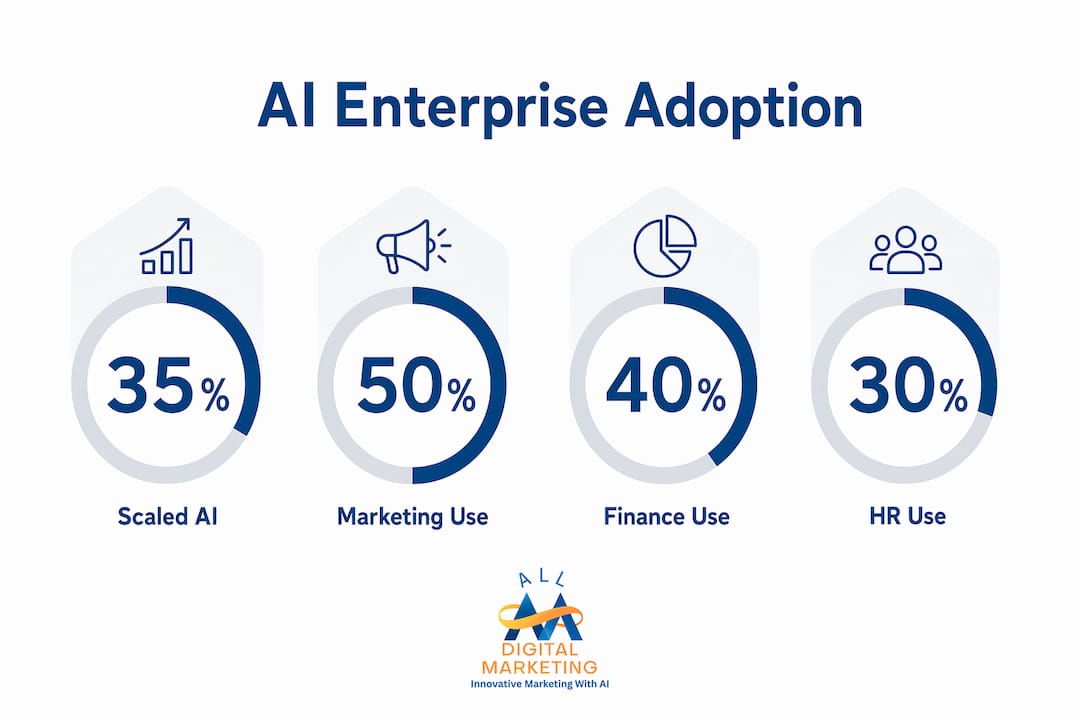
AI is being embedded across functions including marketing, finance, human resources, customer service, and software development. Finance teams use ML models for fraud detection and forecasting. HR departments deploy NLP tools for resume screening and employee feedback analysis. Marketing teams use generative AI for content production and audience segmentation. The AI marketing trends shaping 2026 reflect this cross-functional spread clearly.
Industry adoption is uneven
Adoption rates vary sharply by sector. Finance, information services, and education lead in AI integration. Manufacturing and retail are catching up, driven by supply chain optimization and personalized customer experiences. Healthcare adoption is growing but remains constrained by regulatory requirements around patient data and model explainability.
The key challenges enterprises face when scaling AI include:
- Data quality: AI models are only as good as the data they train on. Inconsistent, incomplete, or biased datasets produce unreliable outputs.
- Legacy systems: Older infrastructure often cannot support the real-time data pipelines that modern AI requires.
- Skills gap: Demand for ML engineers, data scientists, and AI product managers far exceeds supply in most markets.
- ROI measurement: Quantifying the return on AI investment remains difficult, especially for productivity gains that are distributed across teams.
The rise of AI agents
AI agents have evolved from simple assistants into autonomous actors that combine AI models with orchestration logic, guardrails, and observability tools. An agent does not just answer a question. It plans a sequence of steps, executes them using external tools, monitors its own progress, and adjusts when something goes wrong. This architecture, sometimes described as "Model + Harness," is now the standard pattern for enterprise AI deployments in customer service, IT operations, and supply chain management.
Pro Tip: Before deploying an AI agent in production, define its failure modes explicitly. Agents that lack clear guardrails will take unexpected actions when they encounter edge cases, and those actions can be costly to reverse.
A parallel shift is underway in model selection. Many enterprises are moving away from large, general-purpose LLMs toward smaller, domain-specific models. Small language models (SLMs) deliver sufficient performance for tasks like knowledge search, document classification, and customer chatbots at a fraction of the compute cost. That cost difference is becoming a decisive factor as AI usage scales.
What practical impacts does AI have across industries?
AI automates routine cognitive tasks and enables data-driven decisions at a speed and scale no human team can match. The practical effect is not that jobs disappear. It is that job composition changes. AI reshapes roles rather than replacing them outright, increasing the value of work requiring nuanced judgment, domain expertise, and accountability.
Consider how AI changes specific workflows:
- Customer support: AI handles tier-1 inquiries, routes complex cases to human agents, and drafts response templates. Human agents focus on escalations and relationship management.
- Document processing: NLP models extract data from contracts, invoices, and reports in seconds. Legal and finance teams spend less time on manual review and more time on analysis.
- Marketing: Generative AI produces first drafts of ad copy, email campaigns, and social content. Marketers shift toward editing, strategy, and performance evaluation. Professionals applying AI-powered marketing strategies are seeing measurable gains in campaign efficiency.
- Software development: 84% of developers now use AI tools for coding tasks, including code completion, debugging, and documentation. That adoption rate is the highest of any professional category tracked in 2026.
"65% of AI users fear falling behind professionally if they do not rapidly adopt AI tools, yet 45% prefer to maintain their existing workflows. That tension defines the central human challenge of AI adoption: the gap between knowing you need to change and feeling ready to do it." 2026 Work Trend Index, Microsoft
The skills that hold their value in an AI-augmented workplace are judgment, critical evaluation of AI outputs, and domain expertise. AI systems make confident-sounding mistakes. A professional who can identify when an AI output is plausible but wrong is more valuable than one who accepts outputs uncritically. Quality control of AI-generated work is now a core professional competency.
What infrastructure and economic trends are shaping AI technology?
AI infrastructure is expensive and physically constrained. Hyperscaler capital expenditure for AI infrastructure is projected to exceed $750 billion in 2026, up from approximately $450 billion in 2025. That level of spending reflects the compute demands of training and running large AI models at scale. It also signals that the major cloud providers are betting heavily on continued enterprise demand.
Physical bottlenecks are real. Data center supply is a genuine constraint on AI infrastructure expansion. Planned data center projects have been canceled due to local opposition, power grid limitations, and water usage concerns. Those cancellations affect AI availability and latency for enterprises that depend on cloud-based AI services.
How AI pricing models are changing
The economics of AI software are shifting in ways that directly affect enterprise budgets.
| Pricing model | Structure | Key risk |
|---|---|---|
| Per-seat licensing | Fixed monthly fee per user | Underutilization if adoption is low |
| Consumption-based | Pay per API call or token used | Budget unpredictability at scale |
| Hybrid model | Base fee plus usage charges | "Token sticker shock" as usage grows |
AI pricing is shifting from flat per-seat software to consumption-based hybrid models. Enterprises that deploy AI broadly are discovering that token costs compound quickly. A team running thousands of AI queries per day can generate unexpected monthly bills. Finance teams now need spending caps and usage monitoring as standard parts of AI governance.
The move toward SLMs addresses part of this cost problem. A domain-specific model trained on a company's own data costs far less to run than a general-purpose LLM queried through a third-party API. For enterprises with well-defined, repetitive AI tasks, SLMs offer a path to cost-efficient AI at scale.
Pro Tip: Set token usage alerts before you deploy any consumption-based AI tool across a team. Catching a cost spike in week one is far easier than explaining a budget overrun at the end of the quarter.
Key Takeaways
AI is defined by the OECD as a machine-based system that infers outputs with varying autonomy, and understanding that definition is the foundation for every practical AI decision a professional or organization makes.
| Point | Details |
|---|---|
| AI exists on a continuum | Systems range from narrow, rule-based tools to autonomous agents; no single fixed definition applies to all. |
| Enterprise scaling is underway | More than one-third of enterprises have moved AI beyond pilots into core business functions as of 2026. |
| Roles reshape, not disappear | AI changes job composition by automating routine tasks and raising the value of judgment and domain expertise. |
| Infrastructure costs are rising | Hyperscaler AI infrastructure spending is projected to exceed $750 billion in 2026, affecting pricing and availability. |
| Organizational culture drives success | Organizational factors account for twice the impact on AI success compared to individual behavior alone. |
AI adoption is moving faster than most organizations are ready for
I have spent years watching technology cycles play out, and the AI cycle is different in one specific way: the gap between early adopters and late movers is compressing faster than it did with mobile or cloud. Organizations that spent 2023 and 2024 running pilots are now either scaling or falling behind. There is not much middle ground left.
What concerns me most is not the technology. The technology is genuinely capable. What concerns me is that organizational culture and management support account for twice the impact on AI success compared to individual skills and behavior. That finding should reframe how leaders think about AI readiness. Buying better tools does not fix a culture that resists change or a management layer that cannot articulate what "good AI output" looks like.
The professionals I see thriving are not necessarily the most technically skilled. They are the ones who treat AI outputs as a first draft, not a final answer. They bring domain knowledge to every AI interaction. They ask "is this actually correct?" rather than "is this good enough to send?" That habit is the single most transferable AI skill across every industry and role.
My honest view is that the next two years will separate organizations that built AI literacy into their culture from those that bolted AI tools onto unchanged workflows. The first group will compound gains. The second group will accumulate technical debt and frustrated teams. Building AI literacy now, before the pressure is acute, is the highest-return investment most professionals and organizations can make.
— Diane
How Digitalmarketingall supports your AI marketing growth
Digitalmarketingall works with local and national businesses to put AI-powered marketing into practice, not just in theory. If you want to apply what you have learned here to real business results, the team at Digitalmarketingall offers geo-fencing advertising that targets customers by location with precision, and review generation services that build the online reputation AI platforms and search engines use to rank your business. For businesses ready to go further, the partner program connects you with AI-driven strategies built for growth. Explore the full range of services at Digitalmarketingall and take the next step toward making AI work for your business.
FAQ
What is the simplest definition of artificial intelligence?
Artificial intelligence is technology that enables machines to perform tasks requiring human cognitive functions, such as learning, reasoning, and decision-making. The OECD defines an AI system as a machine-based system that infers outputs with varying degrees of autonomy and adaptiveness.
What are the main types of AI?
The four main types are symbolic AI, machine learning, deep learning, and generative AI. Each type handles different tasks, from rule-based reasoning to producing original text, images, and code.
How widely is AI used in enterprises right now?
More than one-third of enterprises have scaled AI beyond pilot projects into core business functions as of mid-2026. Finance, information services, and education lead in adoption rates across industries.
Will AI replace my job?
AI reshapes job composition rather than eliminating roles outright. It automates routine tasks and raises the value of work requiring judgment, domain expertise, and accountability for outcomes.
Why do AI costs vary so much between organizations?
AI pricing has shifted from flat per-seat licensing to consumption-based hybrid models, where costs scale with usage volume. Enterprises running high query volumes can face significant budget unpredictability without spending caps and usage monitoring in place.