

TL;DR:
- AI is rapidly transforming local SEO, making niche keyword research and content essential.
- Optimizing your Google Business Profile boosts local map pack visibility and AI citation chances.
- Combining traditional SEO with structured data and hyperlocal content ensures AI-driven search success.
Local search is more competitive than ever, and AI is changing the rules fast. Businesses that ranked comfortably a year ago are losing ground to competitors who figured out the new playbook. If you run a small or medium-sized business, standing out in search results is not just a nice-to-have—it directly affects how many new customers walk through your door or call your phone. This guide gives you six specific, AI-backed strategies to boost your local visibility, outrank bigger competitors, and stay ahead as search engines continue to evolve.
Table of Contents
- Use AI tools for smarter keyword research and content
- Supercharge your Google Business Profile for local AI and Map Pack wins
- Win the AI Overviews game with structured data and local FAQs
- Dominate micro-markets and conversational search with hyperlocal content
- Monitor your AI visibility—and adapt fast
- Why classic SEO discipline plus AI wins—contrary to the hype
- Partner with experts for next-level local domination
- Frequently asked questions
Key Takeaways
| Point | Details |
|---|---|
| AI supercharges SEO | AI tools help small businesses research keywords and scale content creation for better rankings. |
| Google Business Profile is crucial | Fully optimized profiles drive more traffic, calls, and Map Pack placements, especially with AI involvement. |
| Win with structured content | Schema and local FAQs help your site earn spots in AI Overviews and local search features. |
| Hyperlocal beats city-wide | Targeting neighborhoods with conversational, natural content gives you a real edge. |
| Track and adapt | Measuring your AI-driven visibility lets you quickly spot—and capitalize on—new ranking opportunities. |
Use AI tools for smarter keyword research and content
Now that you understand the challenge, let's start with the foundation of any AI-driven SEO strategy—smarter keyword research and content creation.
AI has changed how you find the right keywords for your business. Instead of guessing or relying on generic tools, AI-powered platforms analyze massive amounts of search data to surface niche, conversational queries your competitors have overlooked. These are the specific phrases real people type when they need exactly what you offer, like "best family dentist open Saturday near Riverside" instead of just "dentist."
The impact is real. AI SEO automates keyword research for 60% of marketers, while also helping generate content outlines and schema markup at scale. That matters a lot if your team is small. You can produce well-structured, SEO-ready content without hiring a full content department. The AI's impact on local SEO is particularly strong for local businesses trying to compete against national brands.
Here's how to put this into practice:
- Use AI keyword clustering tools to group related search terms and prioritize the ones with local intent.
- Generate content briefs automatically so every page you publish has a clear structure, headings, and topical depth.
- Build schema markup in bulk using AI schema builders, which help search engines understand your content faster.
- Target conversational queries by feeding your AI tool questions customers actually ask and turning answers into page content.
- Scale your publishing by producing multiple location or service pages faster without sacrificing quality.
Pro Tip: AI tools give you speed and data, but always layer in your own local market knowledge. You know your customers better than any algorithm does. Combine AI-driven SEO strategies with human insight for results that actually stick.
Supercharge your Google Business Profile for local AI and Map Pack wins
With your content and keywords dialed in, your next focus should be the single biggest local ranking lever—your Google Business Profile.
Your Google Business Profile (GBP) is the most powerful free tool you have for local visibility. When someone searches for your type of business nearby, your GBP listing is often what shows up first in the Map Pack—those top three results that get the most clicks and calls. Map Pack positions deliver 126% more traffic and 93% more calls compared to positions four through ten, and those top three spots average 561 reviews and 993 backlinks. The numbers make a clear case for prioritizing your profile.
Here's a fast-action checklist to optimize your GBP:
- Update your hours every time they change, including holidays.
- Add fresh photos regularly—businesses with photos see significantly more direction requests.
- Post weekly updates about offers, events, or new services to signal active engagement.
- Encourage and respond to reviews because AI systems use review signals to judge trustworthiness.
- Fill in every field, including attributes, service areas, and business description.
| GBP factor | Map Pack positions 1-3 | Positions 4-10 |
|---|---|---|
| Avg. Google reviews | 561 | Much lower |
| Traffic advantage | +126% | Baseline |
| Calls/directions | +93% | Baseline |
AI is now influencing which businesses appear even within the Map Pack, so optimizing Google Business Profile fully gives you the strongest foundation. While 40% of SMBs saw traffic disruption from AI changes, 72% still rate SEO as effective, which means the work you do here pays off.

Pro Tip: Add a Q&A section to your GBP and seed it with real questions your customers ask. AI systems pull from this content when generating snippets and answers, giving you more chances to appear. Check out ranking #1 on Google Maps for a deeper look at what it takes.
Win the AI Overviews game with structured data and local FAQs
Nailing your GBP is vital, but winning the newest AI search features requires a shift in website tactics.
Google's AI Overviews are now appearing in 40% of local search queries, and they reduce how many businesses show up in standard results. If your website isn't structured for AI extraction, you're simply invisible in those placements. The good news: you don't need massive domain authority to win here.
A study of 104,855 AI citations actually shows a negative correlation between domain authority and appearance in AI-driven local results. Semantic relevance—how clearly your site communicates what you do, who you serve, and where you operate—matters far more.
| Schema type | AI Overview citation frequency |
|---|---|
| FAQ schema | Very high |
| LocalBusiness schema | High |
| Review schema | Moderate |
| Event schema | Situational |
Here's how to structure your site for AI Overview wins:
- Add FAQ schema to every service page, answering the exact questions locals search for.
- Implement LocalBusiness schema with your full NAP (name, address, phone), service area, and categories.
- Use review schema to surface star ratings directly in search results.
- Write FAQ pages that answer neighborhood-specific questions in plain, direct language.
- Prioritize entity clarity: make sure every page clearly identifies your business name, location, and specialty.
This local ranking factors guide explains which signals matter most in 2026. For a full checklist approach, the AI lead generation checklist walks you through every step.
Dominate micro-markets and conversational search with hyperlocal content
Once your site's ready for AI Overview extractions, targeting the right searchers means going hyperlocal.
City-wide content is too broad to win in a world where AI can match searchers with hyper-specific local answers. Neighborhood or district-focused pages consistently outperform generic city pages in local AI search results. If you serve multiple areas, build a dedicated page for each neighborhood—not just a list at the bottom of your homepage.
"Earned media accounts for 70-90% of AI citations in local results, compared to just 45% in standard Google results." Geo Dominate AI Search Comparative Study
This statistic is a game-changer. It means local press coverage, community event mentions, and neighborhood directory listings carry outsized weight in AI-driven rankings. Pursuing earned media is no longer optional—it's strategic.
Here's how to build a hyperlocal content strategy:
- Create individual neighborhood pages that mention local landmarks, schools, and community points of interest relevant to your service.
- Write conversational FAQs using the natural phrasing locals use, like "Who fixes AC units in Midtown fast?"
- Publish event content tied to community happenings where your business is involved or relevant.
- Pitch local press and blogs to earn mentions that AI systems treat as trusted citations.
- Join and engage in community sites like Nextdoor and local Facebook groups to build online presence that feeds AI visibility.
This AI strategy guide gives you a clear roadmap for integrating hyperlocal tactics into your broader SEO plan. If you want to see how this ties into Maps specifically, this Google Maps ranking guide is worth reviewing.
Monitor your AI visibility—and adapt fast
Executing these strategies is essential, but domination comes from ongoing measurement and adaptation.
Most SMBs track Google rankings and call it a day. That's no longer enough. AI search engines—including ChatGPT, Perplexity, and Google's own AI Overviews—are citing businesses based on their own algorithms. You need to know where your business appears across all of these platforms, not just traditional search.
Tools like Omnia track AI citations across multiple search engines, giving you a real picture of your AI visibility. This kind of monitoring used to require expensive agencies, but today even small teams can manage it with the right tools. In fact, 50% of SMBs handle SEO in-house, which means you absolutely can do this yourself with the right process.
Here's a step-by-step monitoring approach:
- Choose an AI visibility tracking tool that covers Google AI Overviews, ChatGPT, and Perplexity mentions.
- Set up brand citation alerts so you know every time your business name appears—or doesn't—in an AI answer.
- Review your citation content monthly to identify gaps: Are your FAQs being pulled? Is your schema working?
- Adjust content quickly when you notice a drop in citations or a competitor appears instead of you.
- Use the AI SEO checklist as a recurring audit tool to keep all your signals aligned.
Pro Tip: Review your AI visibility metrics every 30 days. Search algorithms change fast, and a tactic that worked last quarter may need a refresh. Businesses that adapt quickly consistently outperform those that set-and-forget.
Why classic SEO discipline plus AI wins—contrary to the hype
Here's the truth most business owners never hear: AI-only strategies without strong local SEO fundamentals will eventually stall.
Every AI system—whether it's Google's AI Overviews or a large language model like ChatGPT—pulls its answers from structured data sources. And what are those sources? Traditional local SEO signals like GBP, citations, and reviews feed directly into these AI systems. If your fundamentals are weak, your AI visibility will be too. The businesses appearing most often in AI-generated local answers have strong, consistent profiles across directories, healthy review counts, and clean schema markup. AI amplifies good SEO—it doesn't replace it.
Most articles about AI search make it sound like you need to abandon everything you've done before and start fresh. That's wrong. 72% of SMBs still rate SEO as effective in 2026, which means classic tactics still work. The shift is in how you combine them. Entity clarity—making your business identity unmistakable across all platforms—is where AI and classic SEO overlap. You do both by keeping your NAP consistent, earning legitimate reviews, and making your site semantically clear.
The biggest mistake we see is businesses going all-in on one side. Either they chase every new AI tactic and neglect their GBP, or they stick with old-school link building and ignore AI content structure entirely. Integrating AI with SEO best practices is the path that produces durable, compounding results.
Partner with experts for next-level local domination
If you're ready to level up and accelerate your domination path, here's how we can help.
Putting all six of these strategies into action takes time, expertise, and consistency. Our team at Digital Marketing All specializes in exactly this: building AI-ready local SEO systems that get your business found across search engines and AI platforms alike.
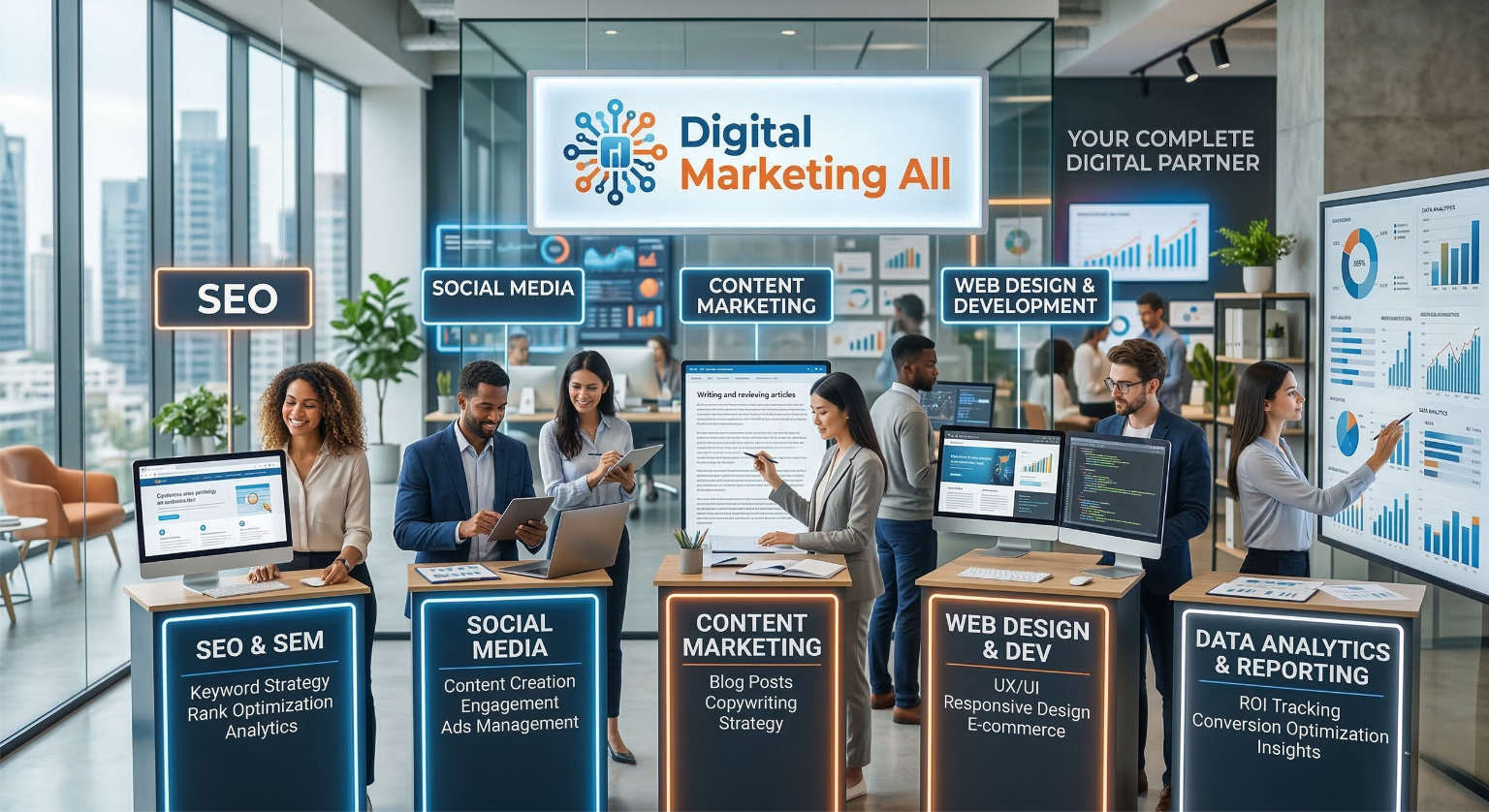
From review generation solutions that help you earn the social proof AI systems rely on, to business voice listings service that ensures your brand appears accurately everywhere it matters, to full LLM optimization services that position you inside AI-generated answers—we cover every layer of your local domination strategy. Let us multiply the work you're already doing.
Frequently asked questions
Do you need backlinks to dominate in AI-driven local search?
Backlinks are far less critical for AI-driven local visibility. A study of 104,855 near-me citations shows that semantic relevance and entity clarity outperform domain authority in AI-generated local rankings.
How often should I update my Google Business Profile?
Update your Google Business Profile at least once a week with new posts, fresh photos, and timely review responses. Consistent GBP activity is one of the strongest signals for maintaining strong local rankings.
Why focus on neighborhood pages over city-wide content?
Neighborhood pages are more specific and match how AI systems deliver hyper-relevant local results. Micro-market pages outperform city-wide content and earn more AI citations, especially as conversational search continues to grow.
What's the fastest way to check if my business appears in AI Overviews?
Use a dedicated AI monitoring tool to track your citations across engines. Tools that track AI citations give you real-time visibility into where your business appears, so you can optimize content and schema accordingly.