

TL;DR:
- AI agents are autonomous software systems that independently execute multi-step workflows, adapt to new information, and pursue user-defined goals through reasoning and learning. They differ from chatbots and virtual assistants by their goal-directed behavior, durable memory, and ability to handle complex tasks without constant human oversight. Responsible deployment requires establishing infrastructure and governance frameworks, such as the NIST AI RMF, to mitigate risks and ensure reliable performance.
AI agents are defined as autonomous software systems that pursue user-defined goals through reasoning, planning, memory, and continuous learning. Unlike AI virtual assistants that respond to prompts or rule-based bots that follow scripts, these intelligent agents execute multi-step workflows independently, adapt to new information, and complete tasks without constant human direction. Platforms like Google Cloud AI agents, Amazon Bedrock AgentCore, and Delight's Agent Steward represent the current frontier of this technology. For business leaders, the practical question is not whether AI agents are capable. The question is how to deploy them responsibly to improve operations, reduce costs, and deliver better customer experiences.
What are AI agents and how do they differ from other AI tools?
AI agents are distinguished from other AI applications by their capacity for autonomous, goal-directed action. Google Cloud defines this class of software as systems that reason, plan, observe, act, and learn in pursuit of a user-specified objective. That combination of functions is what separates them from simpler tools.

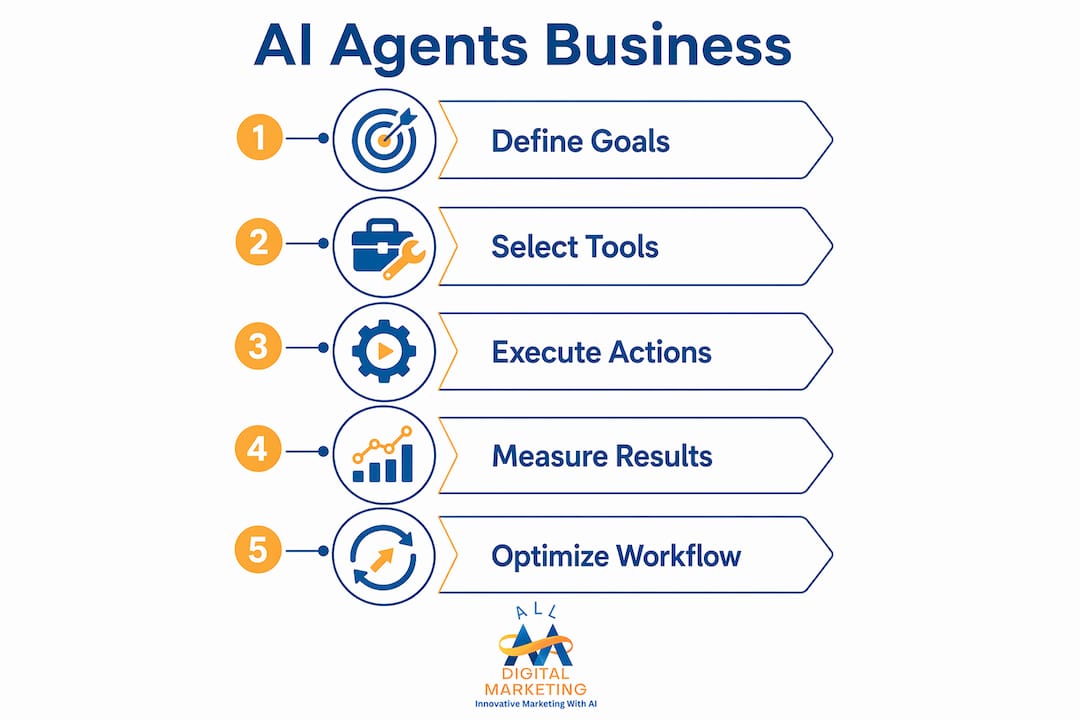
A standard chatbot follows a decision tree. An AI virtual assistant like Siri or Alexa responds to direct commands and retrieves information. An AI agent, by contrast, breaks a goal into sub-tasks, selects tools to complete each one, monitors outcomes, and adjusts its approach when something does not work. This is the core behavioral difference that matters for business deployment.
The architectural elements that enable this behavior include multimodal inputs (text, voice, video, and code), durable memory that persists across sessions, and multi-agent orchestration where a supervisor agent delegates work to specialized sub-agents. Google's ADK architecture demonstrates how agents can manage workflows over days or weeks using explicit state schemas rather than chat history, so context is never lost during pauses or system restarts.
| Feature | AI agents | AI assistants | Chatbots |
|---|---|---|---|
| Decision-making | Autonomous, goal-directed | Prompt-dependent | Rule-based |
| Memory | Durable, persistent state | Session-limited | None or scripted |
| Task scope | Multi-step, end-to-end | Single-turn responses | Predefined flows |
| Learning | Continuous adaptation | Static or periodic updates | No learning |
| Tool use | Dynamic, context-driven | Limited integrations | Fixed integrations |
Pro Tip: When evaluating any AI agent platform, test it on an end-to-end workflow rather than a single question. The ability to complete a full process autonomously is the real measure of business value, not response quality alone.
How AI agents are transforming business operations
The most significant shift AI agents bring to enterprise operations is the ability to handle complex, multi-system workflows without human handoffs at every step. This is not incremental automation. It is a structural change in how work gets done.
Sales and revenue operations
OPLOG's deployment of AI agents built on Amazon Bedrock AgentCore produced results that are hard to ignore. Sales cycles shortened by 35%, CRM data completeness improved by 91%, and prospect research time dropped by 98%. These gains came from specialized agents handling pipeline validation, real-time deal coaching, and social profile lead analysis, all integrated directly into CRM systems and Microsoft Teams. The implication is clear: machine learning agents applied to sales workflows eliminate the manual research burden that slows every revenue team.
Customer service and support
Delight's Agent Steward manages customer service cases end-to-end, coordinating sub-agents across multiple systems and channels. Unlike a chatbot that escalates anything complex, Agent Steward handles multi-step resolutions with approval gates for actions that require human sign-off. This graduated autonomy model keeps humans in control of high-stakes decisions while the agent handles the volume. For businesses running large support operations, this architecture reduces cost per resolution and improves response consistency.
Marketing and content operations
Merck's agentic AI initiative cut compliant marketing cycles by up to 80% and reduced discovery cycles by a third. The prerequisite, as Merck's team noted, was getting the infrastructure right before deploying agents. Orchestration, data pipelines, and system integrations had to be in place first. Businesses that skip this step and deploy agents on top of fragmented systems consistently underperform against those that build the plumbing first.
Business intelligence and reporting
AWS's NarrateAI system uses multi-agent orchestration to deliver real-time conversational business intelligence across organizational roles. The system separates batch processing from real-time interaction, classifies queries automatically, executes sub-tasks in parallel, and validates outputs before delivery. Business leaders get answers to complex operational questions in seconds rather than waiting for analyst reports.
Key business advantages from deploying autonomous AI systems include:
- Reduced cycle times across sales, marketing, and support workflows
- Higher data accuracy through automated CRM updates and validation
- Consistent customer experiences delivered at scale without staffing increases
- Faster decision-making with real-time intelligence surfaced on demand
- Lower operational costs by replacing high-volume manual tasks with agent execution
Pro Tip: Start your first AI agent deployment on a single, measurable sub-task with a clear KPI, such as CRM data completeness or first-response time. Avoid deploying a monolithic agent over a complex workflow until you have validated performance on smaller scopes.
What are the risks of deploying AI agents?
Autonomous AI systems introduce risks that static software does not. When an agent can take actions, call external APIs, update records, and trigger downstream processes, a single misconfiguration can produce compounding errors across systems. Business leaders need a governance framework before deployment, not after.
The NIST AI Risk Management Framework (AI RMF 1.0) provides the most widely adopted structure for this. It organizes AI governance into four functions: govern, map, measure, and manage. Govern establishes accountability and policies. Map identifies the context and potential impacts of the AI system. Measure monitors behavior against defined metrics. Manage responds to incidents and adjusts the system accordingly. Applying all four functions to an AI agent deployment gives organizations a structured way to maintain control as autonomy increases.
The Cloud Security Alliance's Agentic Profile extends the NIST framework specifically for autonomous agents. It introduces autonomy tier classification, which categorizes agents by how much independent action they can take, and tool-use risk modeling, which maps each tool the agent can access to the irreversible actions it could trigger. An agent with access to a payment API, a customer database, and an email system represents a compounded risk chain that must be mapped before deployment.
| Governance area | Best practice | Tools and methods |
|---|---|---|
| Autonomy classification | Assign each agent an autonomy tier | NIST AI RMF, CSA Agentic Profile |
| Tool-use risk mapping | Document irreversible actions per tool | Risk registers, permission audits |
| Runtime monitoring | Track behavioral drift in real time | Telemetry dashboards, alert systems |
| Human oversight | Define approval gates for high-risk actions | Workflow approval systems |
| Incident response | Establish rollback and decommission protocols | Incident playbooks, audit logs |
The most common governance failure in early AI agent deployments is over-automation without safety controls. Organizations that grant broad permissions to agents before validating behavior in constrained environments expose themselves to data integrity issues, compliance violations, and reputational damage. Runtime telemetry and behavioral drift correction are not optional features. They are requirements for any production deployment.
How to implement AI agents in your organization
Successful AI agent implementation follows a sequence that prioritizes validation over speed. The organizations seeing the strongest results, including Merck and OPLOG, share one characteristic: they built infrastructure and governance before scaling agent autonomy.
Here is a practical step-by-step approach for business leaders:
-
Identify a high-value, narrowly scoped workflow. Choose a process with clear inputs, outputs, and a measurable KPI. Sales prospecting research, support ticket triage, or marketing asset compliance checks are strong starting points.
-
Audit your existing systems and data quality. AI agents are only as effective as the data they access. Before deployment, verify that your CRM, helpdesk, or communication platforms contain accurate, structured data. Agents amplify data quality problems as readily as they amplify data quality strengths.
-
Select a modular, multi-agent architecture. Platforms like Amazon Bedrock AgentCore and Google Cloud's ADK support specialized sub-agent design, where discrete tasks are handled by purpose-built agents coordinated by a supervisor. This architecture is easier to test, debug, and scale than a single monolithic agent.
-
Implement durable state management. For any workflow that spans hours or days, agents need explicit state schemas rather than chat history to maintain context. This is a technical requirement that must be addressed in the architecture phase, not retrofitted later.
-
Define autonomy tiers and approval gates. Classify what actions the agent can take without human approval, what requires a human sign-off, and what is outside scope entirely. Delight's Agent Steward model, with its built-in approval gates, is a practical reference for this design pattern.
-
Integrate with existing business tools. Connect agents to the systems your teams already use, including CRM platforms, helpdesk software, and communication tools like Microsoft Teams or Slack. Integration depth determines how much manual handoff the agent can eliminate.
-
Monitor, measure, and iterate. Set baseline metrics before launch and review agent performance weekly for the first 90 days. Track accuracy, task completion rate, escalation frequency, and any anomalous actions. Use this data to adjust autonomy levels and refine the agent's tool permissions.
For business leaders exploring how AI agents connect to marketing automation workflows, the same principles apply. Start with a measurable sub-task, validate performance, then expand scope.
Key takeaways
AI agents deliver measurable business value when deployed with clear scope, durable infrastructure, and structured governance from the start.
| Point | Details |
|---|---|
| Define before deploying | AI agents are autonomous systems distinct from chatbots and assistants; clarity on this distinction shapes deployment decisions. |
| Start with measurable sub-tasks | Narrow, KPI-driven workflows produce validated results before you scale agent autonomy across complex processes. |
| Infrastructure comes first | Durable state management and clean data pipelines are prerequisites, not afterthoughts, for reliable agent performance. |
| Governance is non-negotiable | Apply NIST AI RMF and CSA Agentic Profile frameworks to classify autonomy tiers and map tool-use risks before launch. |
| Results are real and documented | OPLOG cut prospect research by 98% and Merck reduced marketing cycles by 80% using structured multi-agent deployments. |
Why most businesses are still getting AI agents wrong
I have spent years watching organizations adopt new technology in waves, and the pattern with AI agents is frustratingly familiar. Leaders see the headline numbers, such as 35% shorter sales cycles or 80% faster marketing approvals, and immediately ask their teams to deploy an agent. The infrastructure conversation gets skipped. The governance conversation gets deferred. And then the results disappoint.
The uncomfortable truth is that AI agents are not plug-and-play software. They are operational systems that require the same rigor you would apply to any core business process. Merck did not achieve its results by deploying an agent on top of existing chaos. The team built the plumbing first. That is the part of the story that rarely makes the headline.
What I find most encouraging, though, is that the governance frameworks now exist. NIST AI RMF and the CSA Agentic Profile give business leaders a structured path forward. The organizations that treat these frameworks as genuine operating standards, rather than compliance checkboxes, are the ones building durable competitive advantages. The ones that skip them are building technical debt.
My recommendation to any executive evaluating AI agents in 2026 is to resist the pressure to deploy fast. Deploy right. Validate on a single workflow. Measure everything. Then scale with confidence. The AI-driven marketing strategies that produce lasting results follow the same logic: precision first, scale second.
— Diane
Ready to put AI agents to work for your business?
Digitalmarketingall.org helps businesses move from AI curiosity to AI execution. Whether you are looking to automate sales prospecting, improve customer support response times, or deploy AI-driven marketing workflows, the team at Digitalmarketingall brings the strategy and technical expertise to get you there. The resources available cover everything from foundational AI automation to advanced multi-agent deployment for marketing, sales, and operations. Explore the full range of AI automation solutions at Digitalmarketingall and take the next step toward measurable results. The gap between businesses that use AI agents effectively and those that do not is widening every quarter.
FAQ
What are AI agents in simple terms?
AI agents are autonomous software systems that pursue a defined goal by reasoning, planning, and taking actions across multiple steps without constant human direction. They differ from chatbots and AI assistants by completing end-to-end tasks independently.
How do AI agents work in a business context?
AI agents break a business goal into sub-tasks, select the right tools for each step, execute actions across connected systems, and adjust based on outcomes. Platforms like Amazon Bedrock AgentCore and Google Cloud ADK support this through multi-agent orchestration and durable state management.
What are the main benefits of AI agents for operations?
Documented benefits include a 35% reduction in sales cycles, 91% improvement in CRM data completeness, and up to 80% faster marketing approval cycles, based on deployments by OPLOG and Merck respectively. These gains come from eliminating manual handoffs in high-volume workflows.
What risks should business leaders know before deploying AI agents?
The primary risks are compounding errors from broad tool permissions, behavioral drift over time, and compliance exposure from unsupervised actions. The NIST AI RMF and Cloud Security Alliance Agentic Profile provide structured frameworks for managing these risks through autonomy classification and runtime monitoring.
How is an AI agent different from an AI assistant or chatbot?
An AI assistant responds to prompts and retrieves information within a session. A chatbot follows predefined scripts. An AI agent autonomously executes multi-step workflows, maintains persistent memory across sessions, and adapts its approach based on real-time results.